Campamiento Central—> Base de las Torres del Paine (and back)
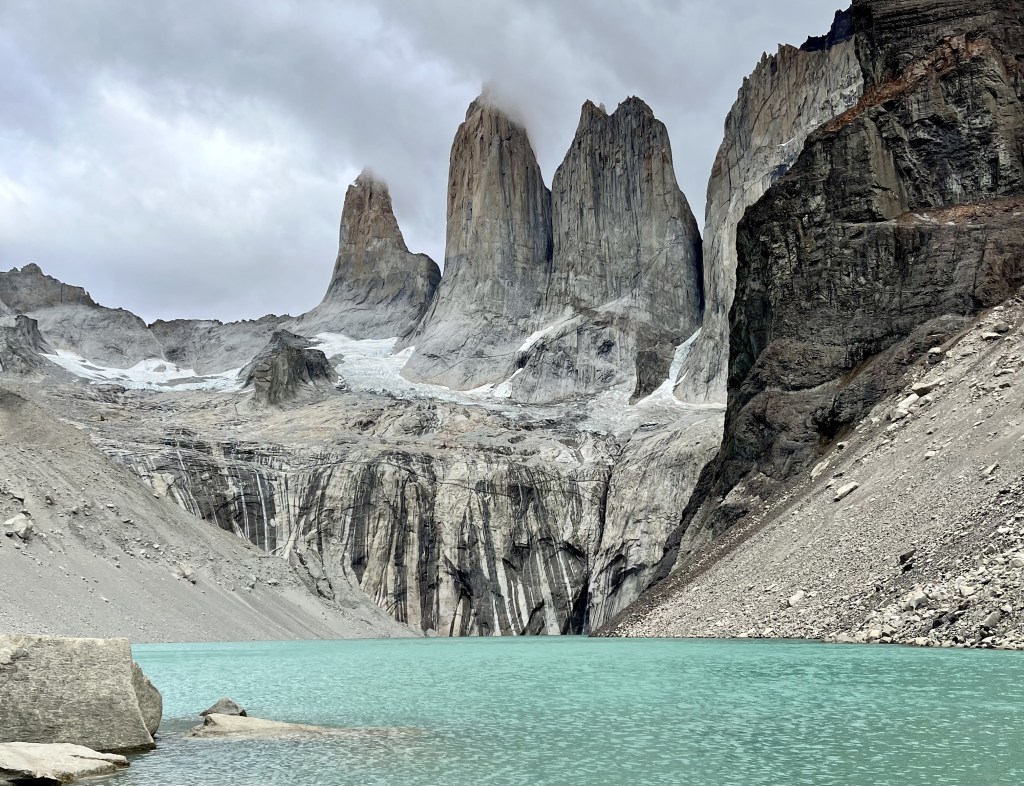
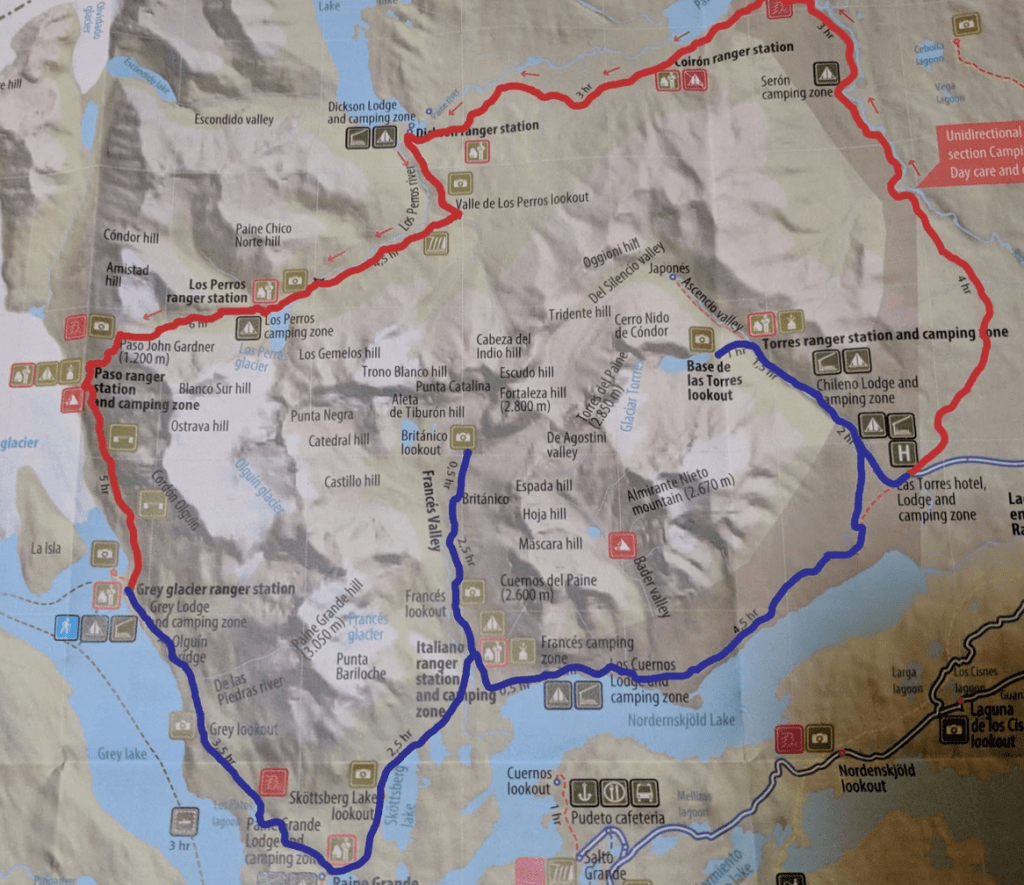
After seven days of backpacking, looming ahead was 21km/13 miles (round-trip) and 901m/2956ft of elevation to reach the base of las Torres, the crown jewel of Patagonia, and my final hike on the O-Circuit.
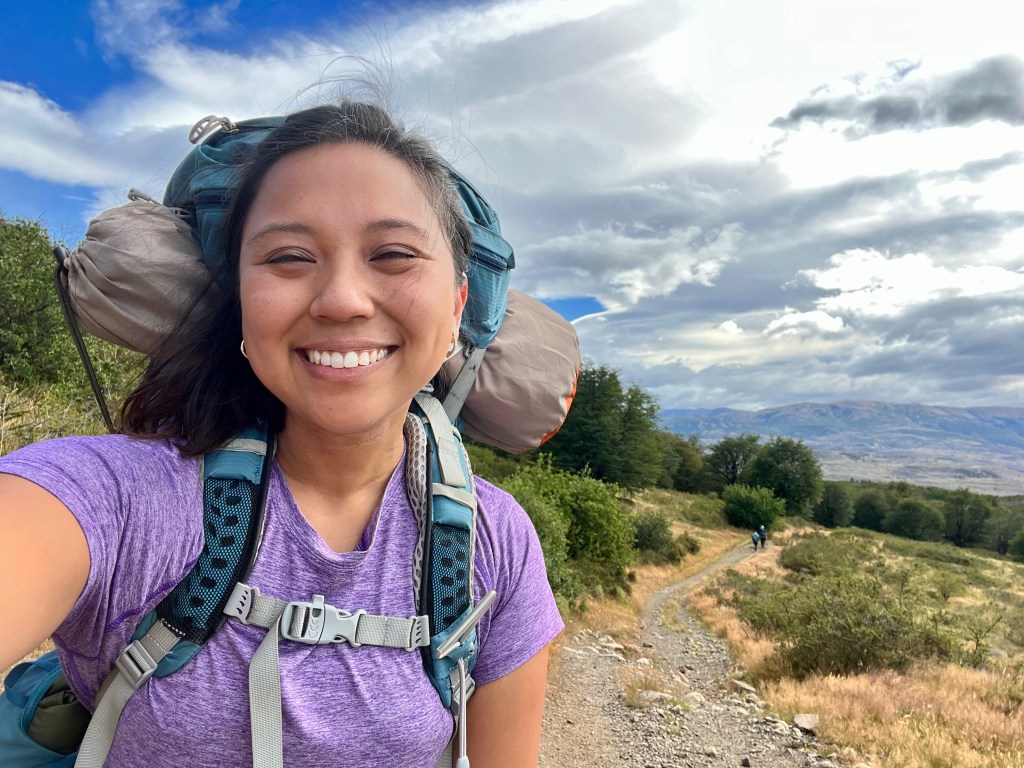
I woke up late that morning, but I packed up my belongings for the last time. Breaking down camp no longer felt like a chore. In fact, it felt like a welcome morning ritual, as routine as brushing my teeth. Since this trail was out and back, I got to leave my 25lb backpack at the campsite then I hit the trail right at 8am.
Hoping to beat the crowds, I hustled, passing large tour groups along the way. I was surprised at how the trail life had conditioned my mind and body in only a week.
For example, my heart no longer raced when I hit aggressive elevation. I had more confidence in my feet as they hopped from rock to rock over running water. My introverted self stopped to converse with friends I made over the past week on the trail. We laughed and hugged each other goodbye, knowing I would probably never see most of these people again. Even though I traveled to Chile alone, because of them, I never really felt lonely.
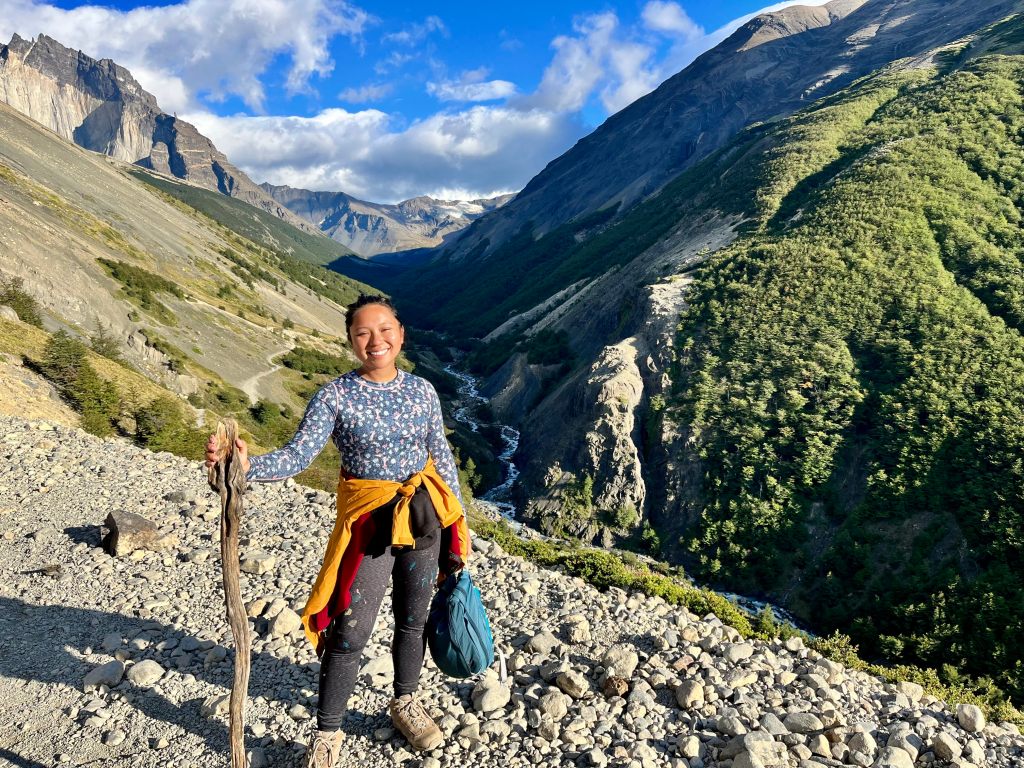
The terrain was aggressive. I was practically pistol-squatting my way up, scrambling over sharp rocks. I gazed down into the valley whenever there was a break in the trees, relishing my last day on the O-Circut. When the trees ended, the trail continued up, exposed to gusts of wind and sporadic buckets of rain. The trail became loose, slippery shards of dark, metamorphic rock. The only way we knew where to go was to follow the orange posts hammered into the ground. Even without my backpack, it was challenging.
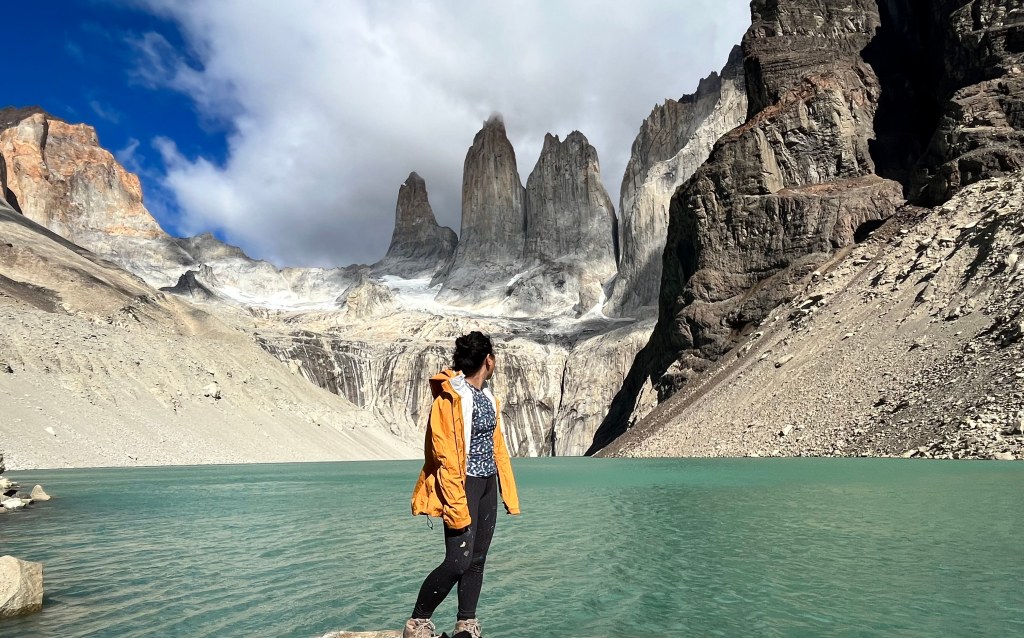
I got to the top at exactly 11:22 AM, the month and day of my mom’s birthday. Her passing a few months prior was the catalyst of my one-way ticket to Chile. Even the wind and rain stopped to reward me with a moment of peace. The glacial lake that sat beneath the three majestic towers was so still I thought it was frozen and everything was quiet. Gloomy clouds pooled at the summits of each tower.
“I heard las Torres are incredible when basked in sunlight, but even in the rain they are incredible,” said my friend Jeff, whom I bumped into while hiking. I agreed. Even in the rain, they are incredible. Everything felt right.
Only six other people were at the Torres with us. It felt beautifully intimate and profound. Jeff and I split a Kind Bar and sat beside each other in silence.
At that moment I felt whole. I felt like I was fulfilling my every potential as a human. Over the last eight days, I maxed out my body, my mind, my social skills, my problem-solving skills, my sorrow, and my self-love in the most healthy way— fully present and one step at a time.
I did it. 8 days and 100+ miles hiked with a 30-pound backpack on these short but mighty Filipina legs. Holy cow, I did it, and I felt…light. I thought I would feel like a hardcore, brave woman at the end of it all, but I surprisingly didn’t feel brave. I felt like sunlight.
I felt free.
A Torres del Paine O-Circut Slideshow from my Camera Roll
Solo backpacking as a young woman is not all the sunshine and butterflies Instagram might suggest. It has been a challenging, tiring, frustrating, and sometimes scary experience, parts of which I feel obligated to share. Of course, traveling is a treasure that I will never regret despite its discomfort.
For example, I am writing this blog post in a public park after feeling sketched out at my hostel. I am all about getting out of your comfort zone, but safety is a priority. So, I packed up, left, and now I must find a place to stay tonight. It is noon, so I have time. Thank goodness for wifi at public parks!
(Disclaimer: This is the only time I felt unsafe at a hostel. Every other hostel experience from Europe to South America has been wholesome.)
So, in the name of transparency, here is a list of 15 realities I have experienced as a solo female backpacker. BUT for every downside, I give you a companion reason why I feel like I’ve grown because of it!
15 Lessons Learned as a Solo Woman Traveler
1. Days spent on logistics
Instagram shows the culmination of hours of planning. What you do not see is the time spent locating the nearest grocery stores, managing schedules, comparing tour prices, organizing transportation, chasing wifi hotspots, and constantly planning your next move. It’s exhausting and unexciting.
Why it’s worth it: You will become so incredibly travel-savvy that international trips will feel like a breeze. Airports, boat docks, and bus terminals will feel like a walk in the park. You will be less forgetful, ultra-prepared, and full of confidence.
2. Not speaking the language well enough
I came to Chile speaking a decent amount of Spanish, but the accent was difficult to understand. Additionally, surprisingly few people speak English in Southern Chile, and it was a challenge to communicate at first.
Why it’s worth it: In time, your communication skills will skyrocket! Whether you are speaking the language more fluidly or just understanding the best ways to use your body or resources, it will benefit you in the long run!
3. Loneliness
Whether you speak the language or not, a bit of loneliness is inevitable when traveling solo. You see your friends from home having a picnic while you are alone in a tent in the middle of the Patagonian backcountry. Then again, that’s pretty cool, and I am sure your friends from home would approve.
Why it’s worth it: Friends are easy to come by when traveling! Find hostels where there are plenty of opportunities to socialize. Campsites have been my social hub where everyone is searching for a trail family. Keep an open mind, and see what the universe provides!
4. Piling expenses
It’s a challenge to stay within budget, especially if you’re going to a country where the exchange is not in your favor.
Why it’s worth it: You will become a master at personal accounting and ingenuity. You will learn to determine which experiences matter the most to you, and sometimes skipping out on that $90 tour will open up other, more culturally authentic experiences. Reading a book in the plaza while eating a homemade sandwich gives you a more personal look at local life that an expensive city tour with other tourists ever could.
5. Eating a balanced diet can be effortful
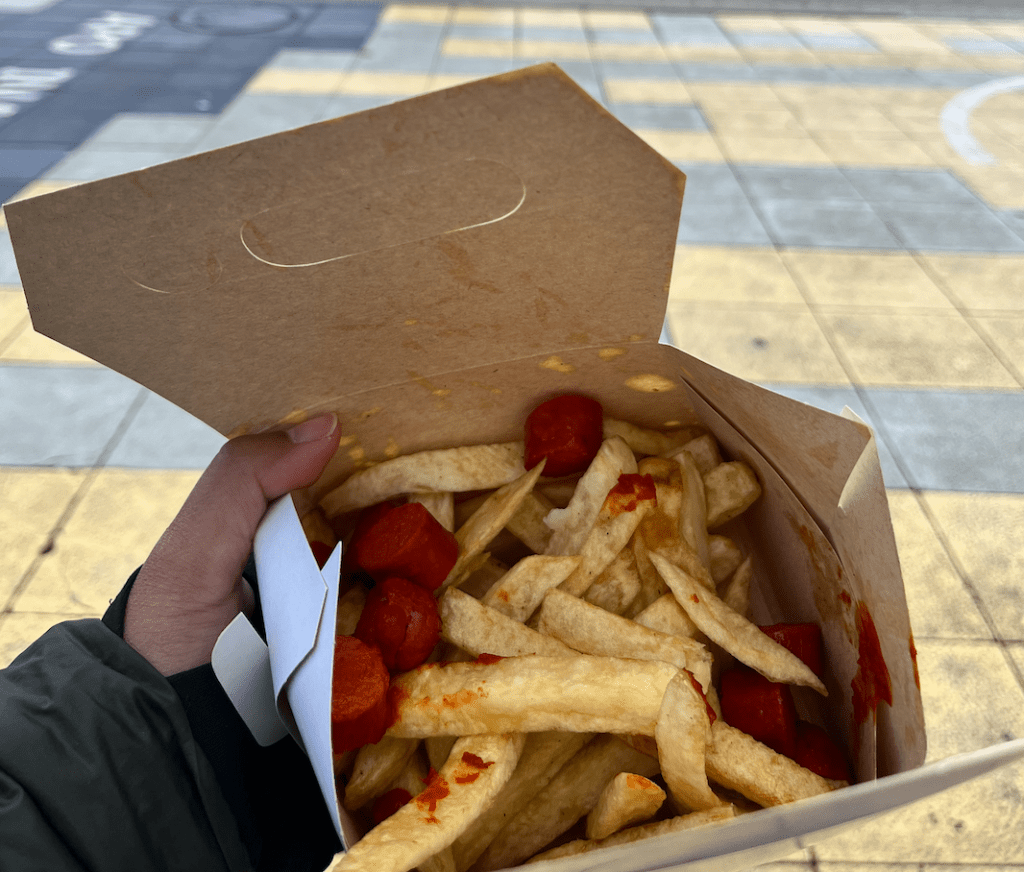
Gotta love salchipapas.
You are at the mercy of whatever is available. If all you find at the tiny local market is cilantro, then you just have to deal with it. I realize that my diet for the last two months consisted of 90% bread and potatoes.
Why it’s worth it: Backpacking requires energy so enjoy the mass amounts of bread and potatoes stress-free. If anything, it will force you to explore different grocery stores to find spinach or any other veggies you crave. It is another intimate look into the real lives of people as you scour the local stores.
6. Unreliable public transport
I realized it is not uncommon to wait an extra hour for your bus, especially when you are far away from any major city and hitchhiking is a common mode of transportation. Or maybe your driver left, and you have to wait in the rain while you wonder where he went. It can be uncomfortable and inconvenient.
Why it’s worth it: It forces you to think on your feet and roll with the punches. Embrace the laid-backness of life, especially if you come from the States where you are over-accustomed to convenience and instant gratification. My tour guide once picked up a hitchhiker while riding in his Sudan on the way back from a kayaking excursion. We ended up all having a memorable conversation in the car together. Just go with the flow, and be open to what can happen if you are not so focused on the plan.
7. Being dirty for long periods
Showers are not always available on thru-hikes, and sometimes you do not want to deal with cold-water-only hostels. Your backpack could not fit your entire skincare routine, and the hikes have disgustingly destroyed your feet. Eyebrows are bushy, and your 18-in-1 soap just isn’t cleaning your body the way it cleans your dishes. Also, your clothes reek.
Why it’s worth it: You will come to love and appreciate your body for how well it functions over how it looks. You will gain an appreciation for water as you have never known. Also, when I shower, I can wash my clothes simultaneously! How resourceful you will become!
8. Tourists on tourists
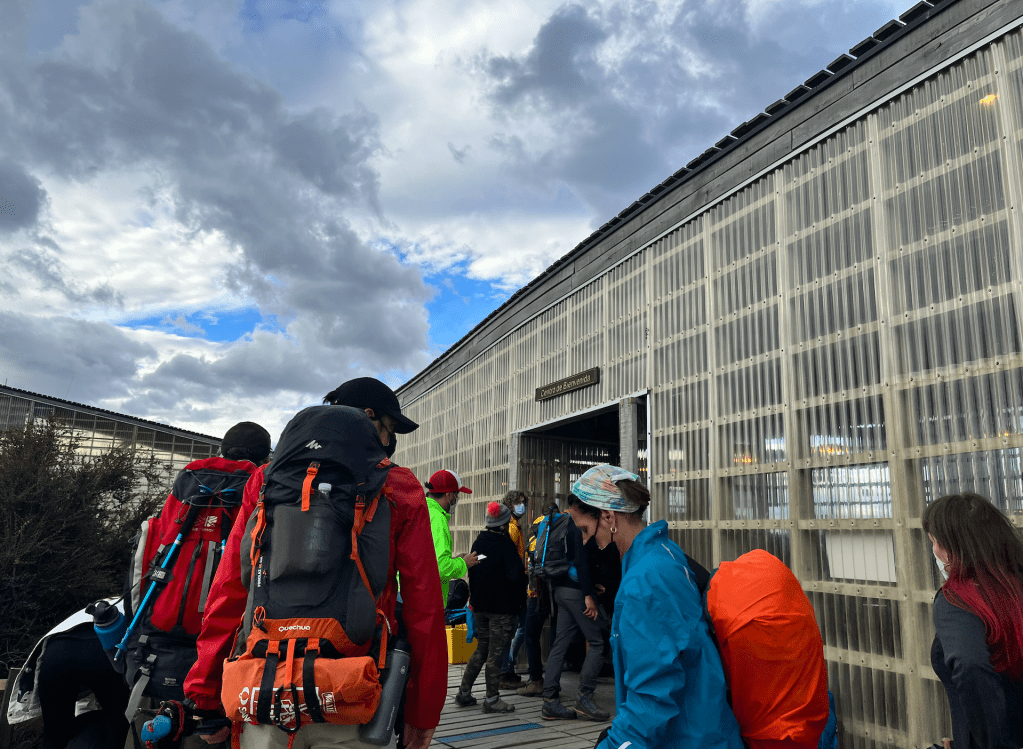
Welcome Center at Torres del Paine National Park
Waiting in line sucks, and crowds around the main viewpoints kill the mood.
Why it’s worth it: It will force you to wake up hours earlier to avoid crowds, thus being rewarded with the most incredible views. If avoiding crowds is impossible, see it as an opportunity to enjoy the company! Enjoy sharing a precious experience with people who share the same interests as you. It is a privilege to travel, and crowds mean you are seeing something special.
9. Animal carnage
I went to Isla Magdalena, a Penguin Monument near Punta Arenas. Thousands of precious penguins waddled around the island, but there were also plenty of not-so-precious sights. Dead birds sprawled across the island, and in the distance, you can see the carnage happen right before your eyes. Unnerving and sad.
Why it’s worth it: Watching penguins being ripped apart by opportunistic birds of prey is an image I will never forget. BUT, how beautiful is nature! Gotta appreciate life in the wild. Better than seeing penguins in the zoo, right?
10. ALL THE DANG DOGS
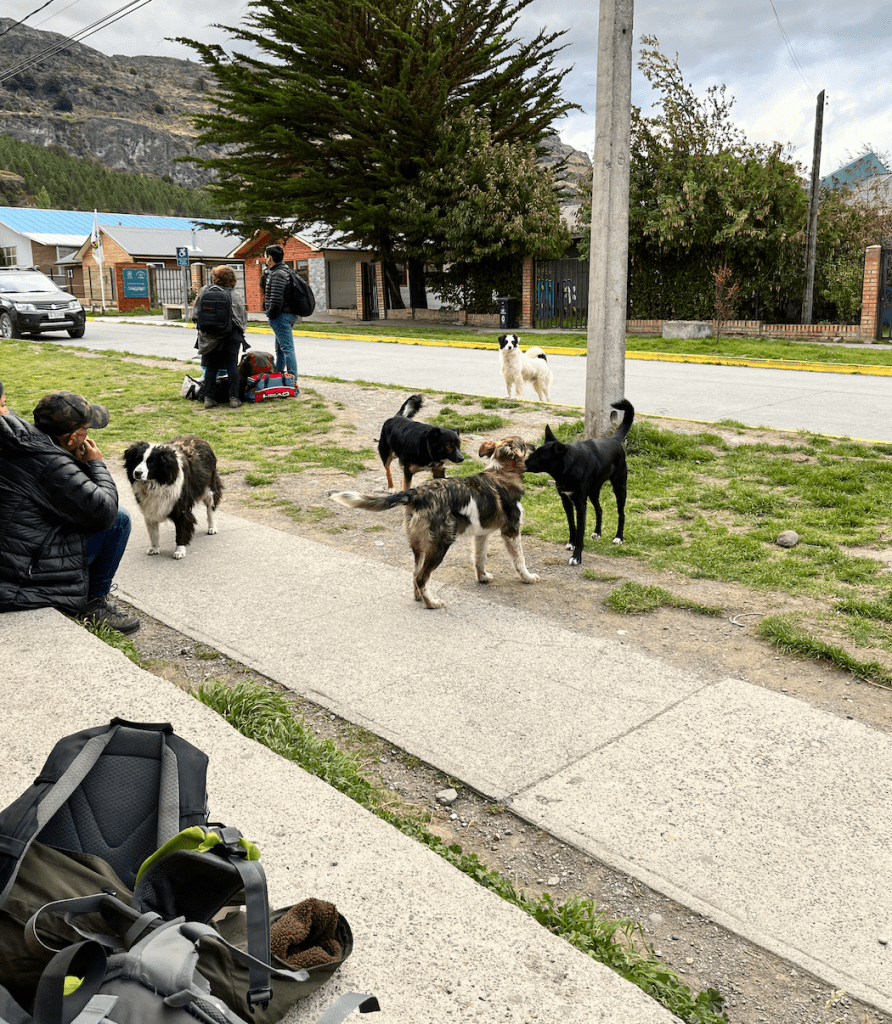
Dogs gather at the bus stop in Puerto Rio Tranquilo. These doggos are friendly.
Country dogs are fierce, and they protect their family and livestock well. Unfortunately, sometimes you have to bear the burden of walking through their land. I HATE being chased and barked at by big, unleashed dogs. I still change streets when I see a dog ahead, but sometimes I have no choice but to walk forward.
Why it’s worth it: You will practice composure! Dogs are everywhere, and most of them are not aggressive. Eventually, you will appreciate all the doggos that can keep you company!
11. Uncomfortable accommodations
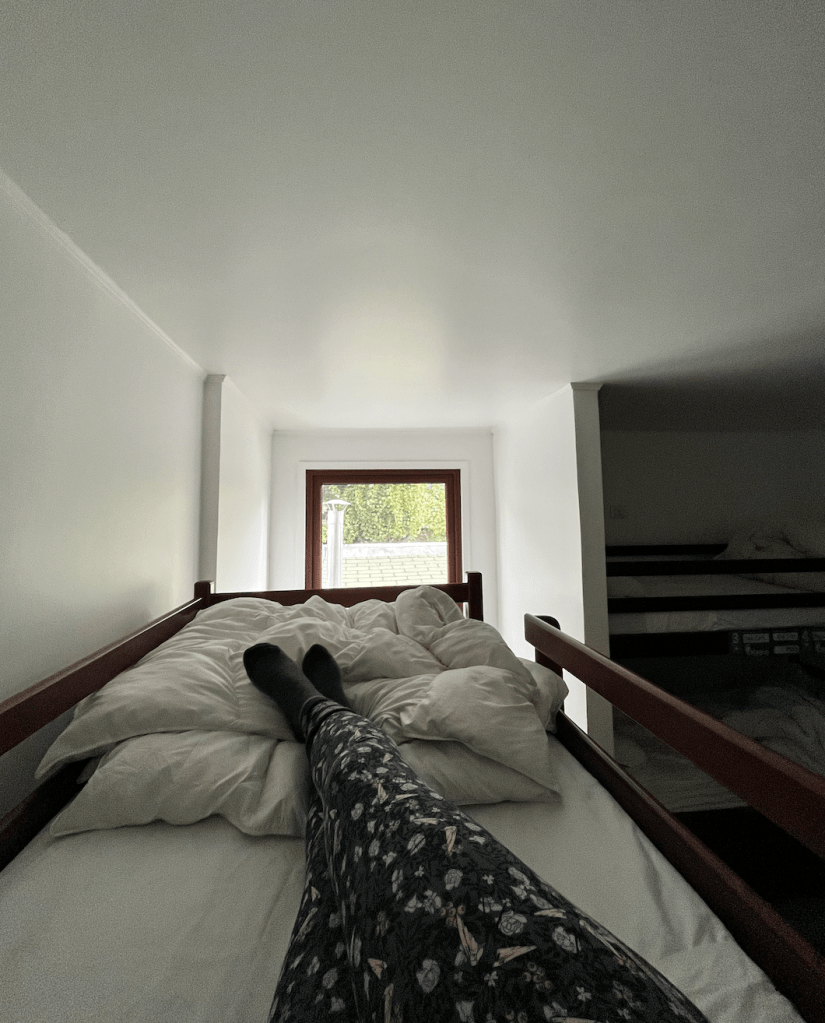
Bugs at your campsite. Spiders in the showers. Smelly bathrooms. Holes in the walls of your hostel. No air conditioning/heater. Sharing a room with five others. Chickens in the kitchen. Cold showers. Bumpy five-hour drives while your driver listens to loud music and drinks a beer.
Why it’s worth it: You will appreciate the basics, the people who welcome you into their lives, and your body that can adapt.
12. Harassment
Being a solo woman traveler, unfortunately, you know this is coming. Being alone appears to be an invitation to some, and it is incredibly shitty.
Why it’s worth it: You will learn that it is okay to be angry and NOT be polite! You will become comfortable defending yourself, and you will not let it keep you from living your best life. You will also learn that there will always be someone there to help. For every one shitty person, many others are kind.
Campsites in Patagonia often have shared cooking and living spaces that concentrate the wifi. All my phone calls to home had to be done in public. Also, sharing a room in a hostel is too affordable to pass up, but the catch is that you share a room with strangers. You share the common spaces, the kitchen, and the bathrooms.
Why it’s worth it: You’ll learn to share, to get comfortable with being uncomfortable. It also forces you to learn how to set boundaries. Also, campsites and shared hostels have been home to some of the most fun I had on trips! It was so easy to make friends.
14. Having only one of everything
To save on weight, I strategically plan the contents of my backpack so that I only carry the necessities. Unfortunately, if I lose one thing, I will feel it. I already lost my water bottle and my headlamp.
Why it’s worth it: You will become more resourceful and proud of how well you manage.
15. Guilt
Traveling is tiresome, and I want to spend some days sitting in bed watching movies. I do not want to hike, take a tour, or socialize. BUT then I feel as if I am wasting time. Traveling is an incredible opportunity, and I want to be in bed?!
Why it’s worth it: You will learn how to validate your feelings and how to best take care of yourself. You will appreciate rest.
Campamiento Grey —> Campamiento Frances —> Campamiento Central
After hiking eight grueling hours under a beating sun from Campsite Grey to Campsite Frances, I had a Snickers, a pot of curry-flavored quinoa, and half a can of beer. The other half I spilled in my tent.
At this point, I accepted the sloppiness of my existence, like “showering” with a Neutrogena wet wipe or spit-launching dusty loogies without breaking my stride on the trail. Anyway, I thought about sleeping in the nude, but the bitter cold convinced me otherwise, so I slipped on my least dirt-crusted clothing and relished the warmth. That night I had the deepest sleep of my life. Cushy beds in Vegas Venetian Suites paled in comparison. Not that I experienced those too often.
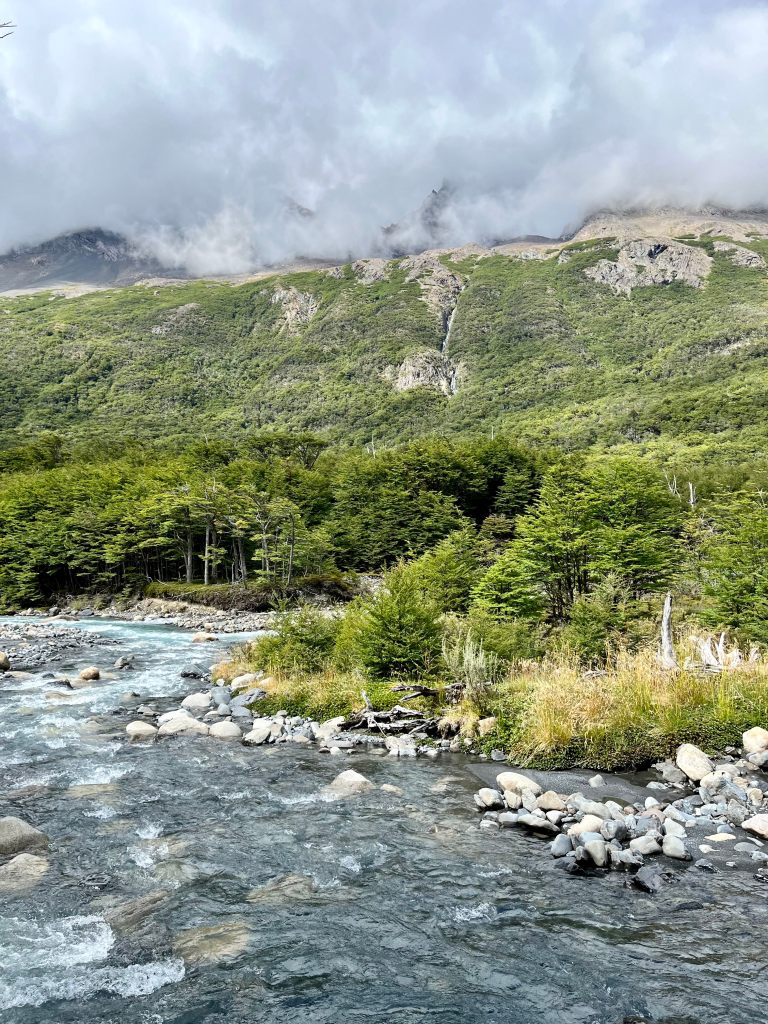
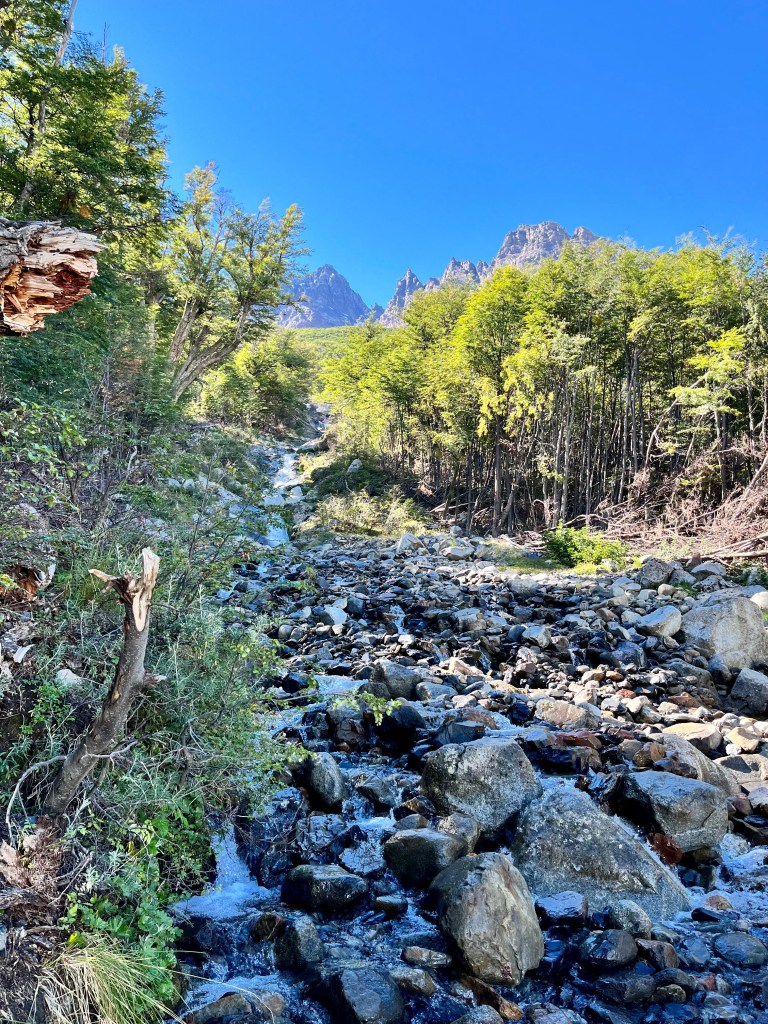
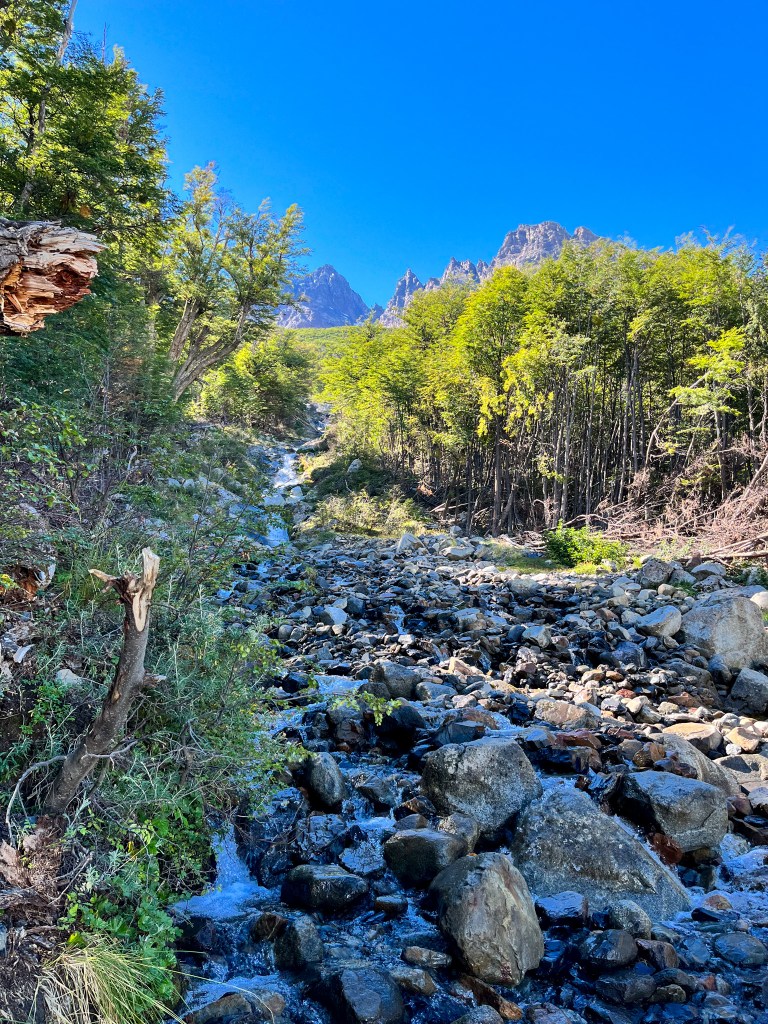
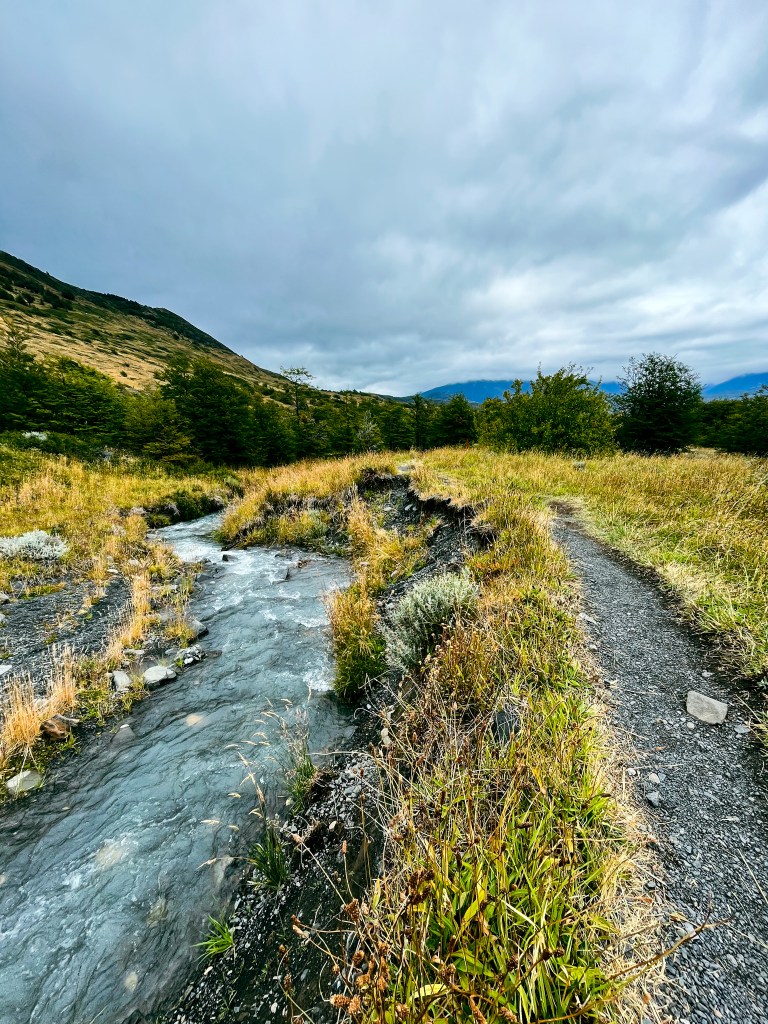
See that river? Yeah, that’s the trail.
I woke to the smell of my beer-soaked tent. Without complaint, my body sprung into the morning ritual. Within 30min of waking up, I was on the trail chomping on mouthfuls of peanuts as I marched.
I marveled at how my body had changed, even after just a week of backpacking. My lungs breathed deeper, my skin was smoother, and my thoughts were kinder. The weight of my backpack was less burdensome, and elevation gains no longer made my muscles scream like they used to. Now I can simply relish the view without cursing the earth beneath me.
During the last section of the 12ish-mile hike to Campsite Central, I met a new friend. This man would hike past me, then I would pass him, then he would pass me, and we did that for miles until eventually, we stopped to talk.
“Es hermoso, no?” He asked me in Spanish. He walked up behind me while I was admiring a nearby lake.
“Sí. Es ummm… lo siento mi español es muy malo, pero queiro practicar!” I wanted to say so much more about the lake, but I did not have the vocabulary.
“Oh don’t worry. I speak English. Where are you from? Also, yeah, let’s practice!”
He was a young, sweet Chilean man who spoke with intensity and passion. We walked a few miles together, switching between English and Spanish. We talked about Chilean history, people uprisings, feminism, and the environment. I learned more about Chilean bureaucracy than I ever thought I would.
I remember listening to him talk about hope as I gazed out onto the neverending trail. A cool breeze made the hot sun tolerable, and there was a satisfying crunch of dirt beneath our boots as we marched in matching strides. The dramatic metamorphic mountains, glaciers, and waterfalls were behind us as we ventured towards the Welcome Center, exactly where I started seven days before. I wondered how I would feel when I would eventually arrive. All the positive changes I mentioned came from living out in nature, but how would I fare back in the “real world?”
After a few hours together, my new friend decided to stop at a river to relax. I continued without him.
I crossed the last suspension bridge, pushed through one final steep elevation gain, and saw my final campsite. A wooden sign indicated that the Welcome Center was just up the road, but a hotel and parking lot already alerted me that I had returned.
I stopped walking. My eyes spilled with joyful tears, and my stomach knotted with excitement. Seeing the hotel made me smile and laugh as I audibly whispered to myself, “Holy crap. I did it.” I completed the Torres del Paine O-Circuit! 80 miles in seven days. 30.1 miles in just the last two.* I arrived back exactly where I started, but I could not have felt more different.
With newfound energy, I set up my campsite swiftly, my hands working on automatic while I daydreamed about the next day, my last hike in the park, the grand finale: an 18-mile* round-trip trek to the base of Torres del Paine. At least I could leave my backpack at the campsite.
I walked to the little store to buy myself a coke and an hour of wifi. There, I bumped into my Texan friend (the man I hiked with for 11 hours over the John Garder Pass). He was sunburnt, dirty, and leaner, but he looked so happy. “I want to hear all about your last few days!” He said as we hugged.
He bought me another coke and one for himself. Rain began to pour as we excitedly recounted our adventures as the sun set on the distant Torres del Paine Towers, our final destination.
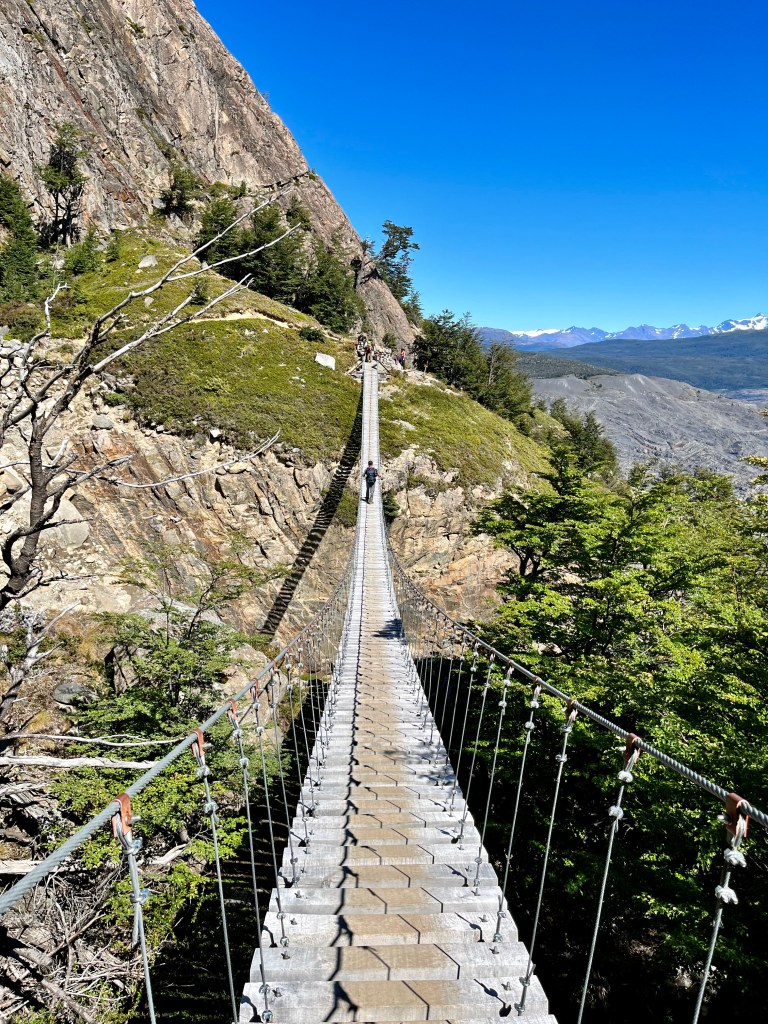
Quick mid-hike swim!Last waterfall on the way to Campsite Central.Taken from the last suspension bridge on the trail.Patagonia, my heart.
*On maps, the distances between campsites are written straight-shot, point-to-point. They don’t count the miles of switchbacks, loops, and bends that a person must hike between point A and point B. I’m basing my mileage on the data I got off my phone days after I finished the trek.
“Tomorrow, the hike will be around 13 miles but last 11-12 hours. It will start with a 6,400 ft incline until the John Gardner Pass, then about a 9000 ft descent that will last around two to three miles. It is STEEP. If you don’t have trekking poles, find a good stick. After that, you’ll have around five hours left before you reach the next campsite. I suggest an early start.”
The ranger briefed me on tomorrow’s hike to Glacier Grey, looking concerned that I was one of the last people to arrive at the Los Perros Campsite that afternoon. I reassured him that I spent a few hours writing by the glacier. I’m not such a slow hiker.
My cozy spot at Campamiento Los Perros
“No writing or reading tomorrow. Stop to take a quick photo, but then keep walking.”
I nodded, scavenged for a perfect walking stick, and snuggled into my sleeping bag before 8 pm.
I woke up pre-dawn the following morning, swallowed a handful of trail mix, and followed a group of other hikers up into the forest. They were faster than me. It was dark, and the already aggressively steep trail was covered with fallen branches. I lost the group within thirty minutes, and I lost the trail soon after.
I couldn’t hear anyone around me, and I couldn’t see anything beyond the glow of my headlamp.
“HOLA!?” I yelled.
Silence.
“HELLO?!?!”
Nothing.
My heart started to race while I speed-walked through the trees, scanning my surroundings for the trail. Even though I climbed in elevation, the forest was so thick I could not get a clear view of what was below.
I high-kneed my way over tall bushes across the mountainside, hoping I would run into someone. Worst case scenario, I would walk back down, and I was positive the campsite would be easy to find. I wasn’t in any real danger, I told myself.
I lowered my body into a narrow, dry riverbed, suppressing panic tears, when I heard, “Oh hey, Jessica!”
It was a Texan man I met on my first day in Torres del Paine National Park. He was trekking up the riverbed. I was on the trail!
“I’m glad I ran into you! I was told this hike can get pretty gnarly, so it’s best to do it with a buddy. Want to walk together?”
We started back at that lake!
I agreed, though my fear of getting lost was now replaced with a fear of holding a conversation with a stranger for possibly 11 hours. At least my mind was too wrapped up thinking of conversation topics that I paid less attention to the steepening incline until it was painstakingly impossible to ignore.
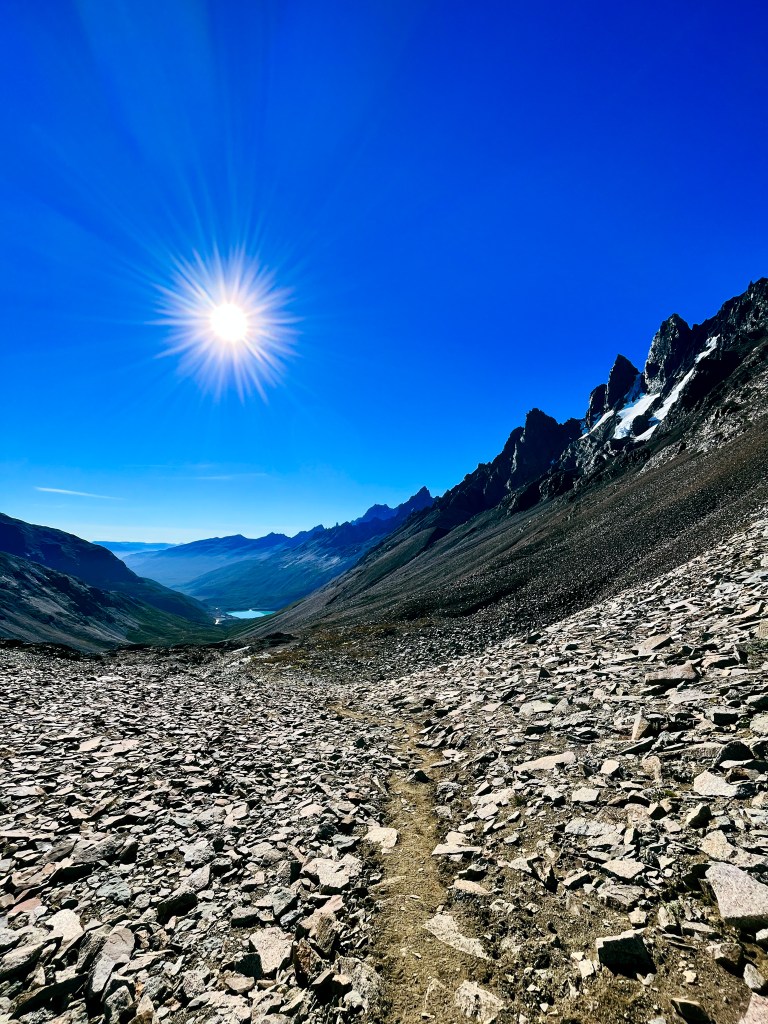
The trail left the forest and brought us into a clearing of loose rocks and draping glaciers as we ascended the pass. Orange metal poles jutted out of the earth indicating that the trail continued up as far as I could see. Teeny tiny backpackers ahead were slowly trudging up and behind a mountain. I hoped the incline ended there. (It didn’t.) Glacial runoff spilled from the direction we walked up, making the loose rocks even more slippery. Thank goodness it was a windless, sunny day. The trail could easily be a treacherous hike under worse conditions.
The conversation between my partner and I shrank into groans, numerous comments about burning calves/hamstrings/etc., and asking each other, “how much longer, you think?” As if either of us knew.
A wooden sign presented itself. My friend read it while I caught my breath, hands on my knees. “We’re about 1/5 of the way done, according to this map.”
Took a photo because I thought this was Glacier Grey. It wasn’t, but it was still spectacular!
Hours passed, and as magnificent as my surroundings were, I looked down at my feet as I walked. If I kept my head up and looked ahead, I would get discouraged, my heart would beat faster with overwhelm, and my body would ache more. So focusing solely on the next step was the only way I could convince my mind and body to keep moving.
“An inch is a cinch, but a yard is very, very hard,” My mom used to say.
I trudged on and on and on. Higher and higher and higher until…
“Jess, look up!” My friend said breathlessly.
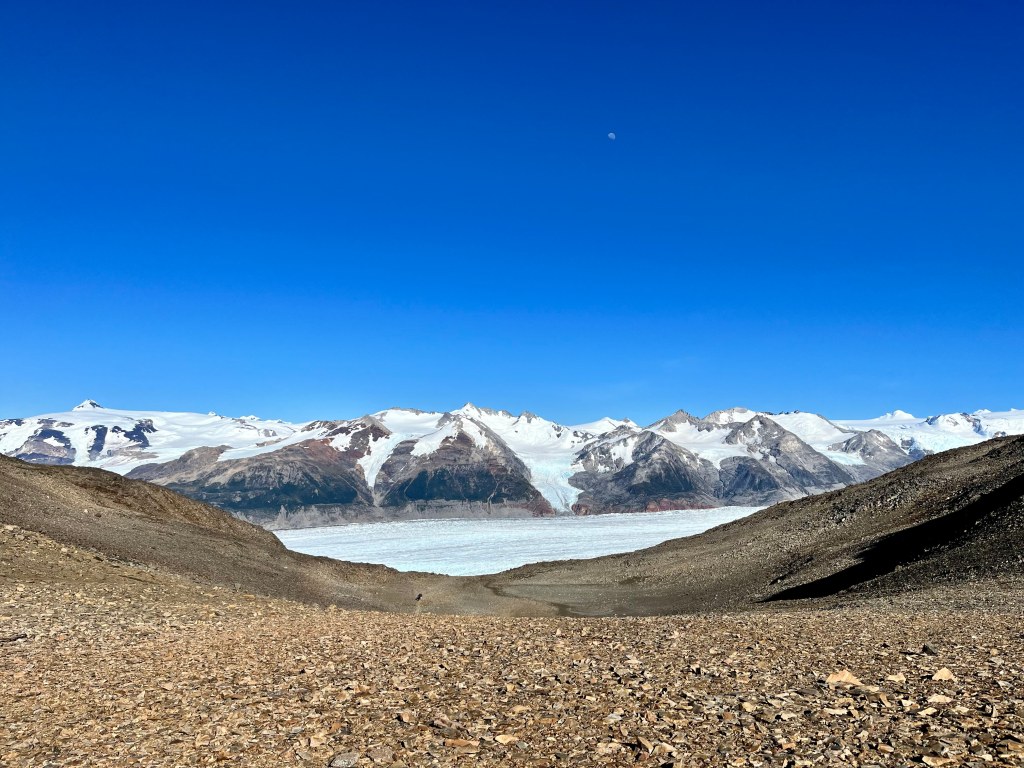
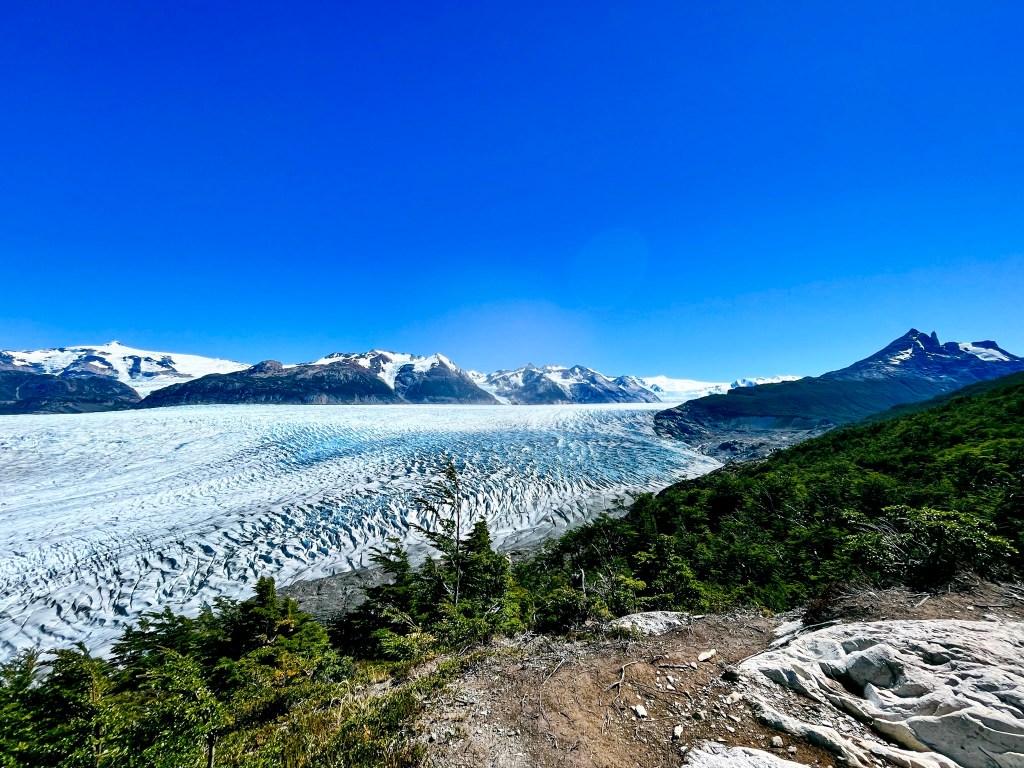
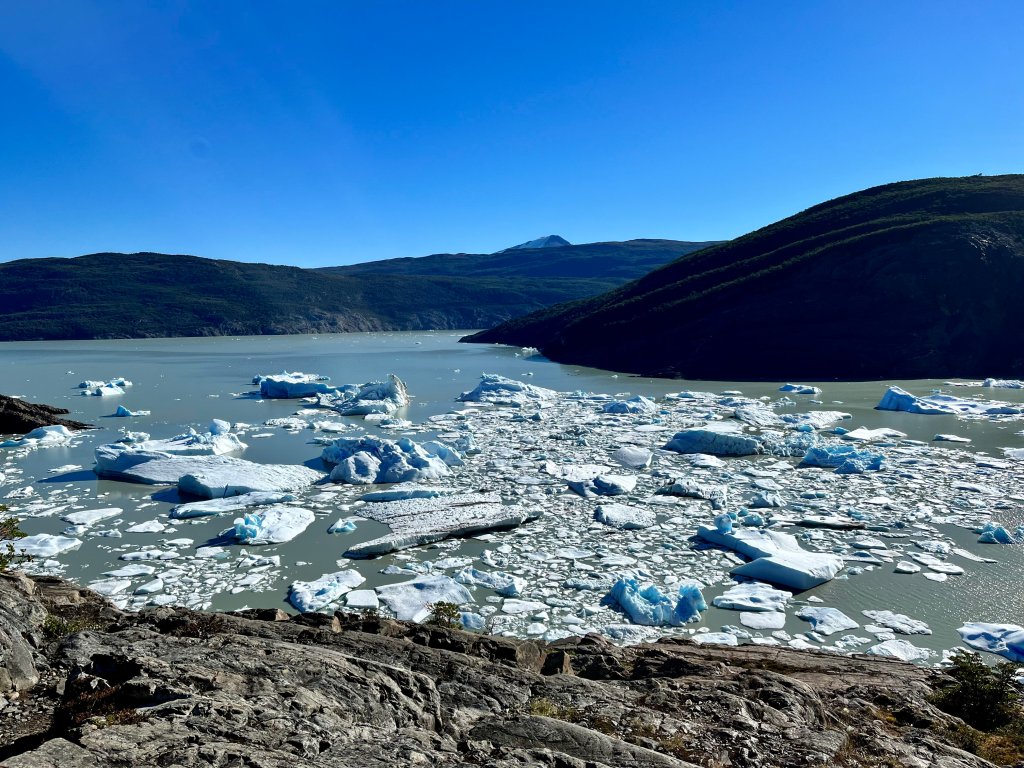
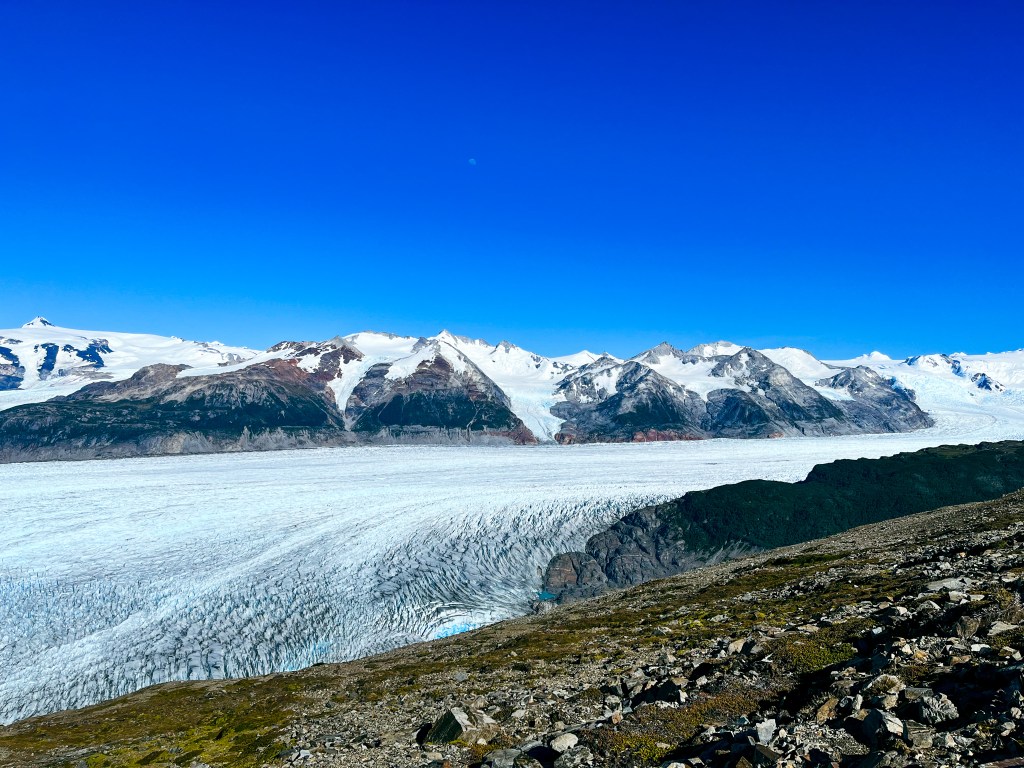
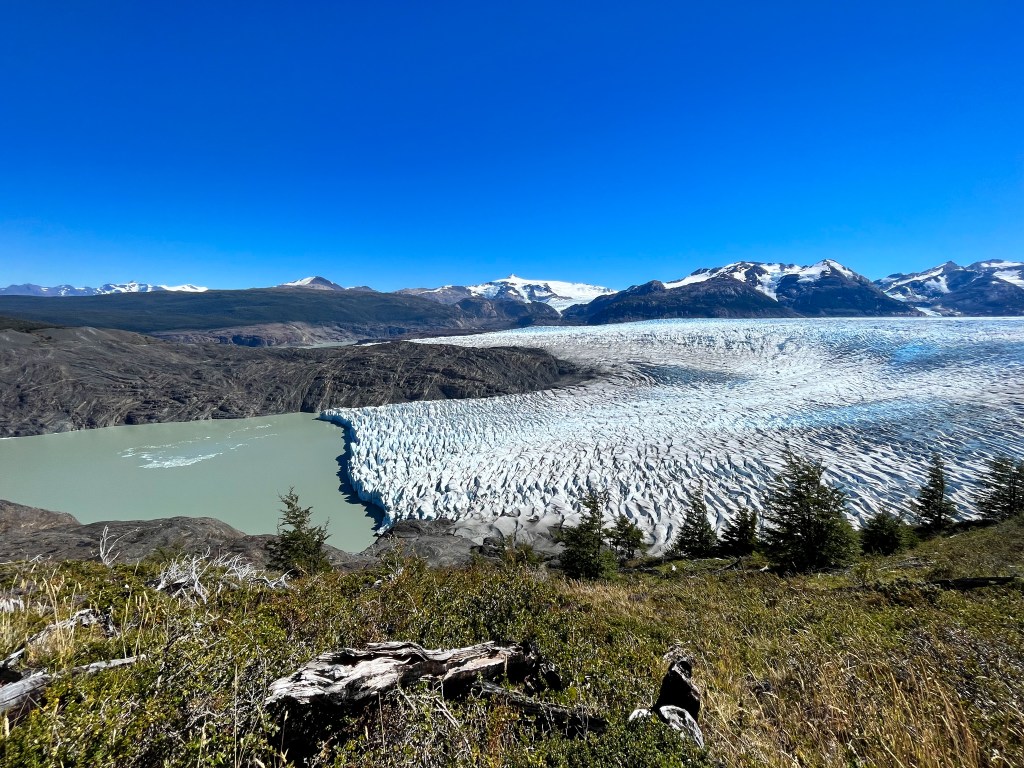
I looked up, and my jaw dropped. We reached the summit of the John Gardner Pass, and ahead of us was Glacier Grey. It expanded across my peripherals, and even when I turned my head, I couldn’t see where it ended. It was gigantic. The ice field spanned across the bases of six or seven mountains, and a luminous baby blue hue glistened in the valleys and caves within it. Distant, thunderous howls erupted from the mighty glacier as it calved in places I couldn’t see.
I took off my backpack and sat while my friend opened his one pack of M&Ms in celebration.
It was just us, our aching muscles, a frigid wind, a powerful silence, and a 100 sq. mi. glacier. I felt so small and insignificant but in a beautiful way. The experience commanded a shift in perspective. My anxieties, pain, joys, past, present, and future matter, but I realized how foolish it was to believe my reality ended there. True reality is shared, constantly shifting, and expanding. Even this thousand-year-old massive glacier is merely a speck in the universe. So what am I?
The universe is infinite. It is a reminder that life events are important, but in the grand scheme of things, the itty bitty moments that make up our lived experiences do not matter as much as we think they do. A failed business venture, a breakup, an embarrassing moment, and even the death of someone important. All that matters and is worthwhile to hold dear, but the possibilities to learn and live in life go beyond what we personally experience. We just need to be open to going beyond our ego to find it. Fear, suffering, and pain are even smaller specs in this universe, as is joy. And oddly enough, that makes me feel free.
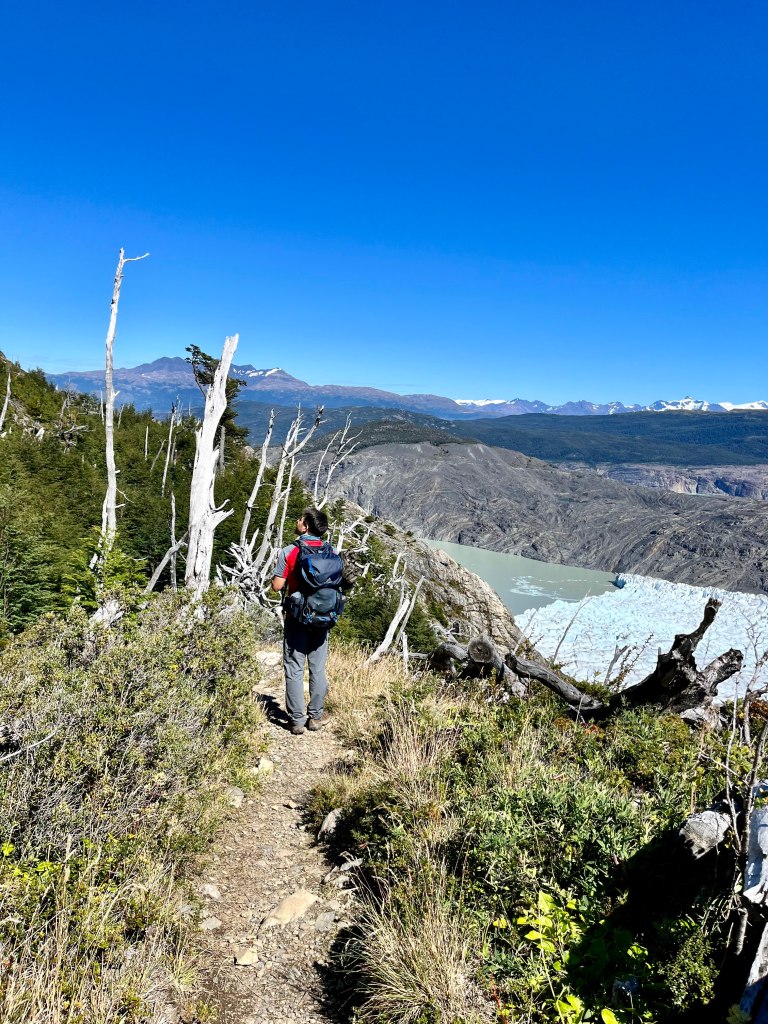
After an excruciating six more hours (where I experienced the steepest descent of my experience as a hiker, multiple adrenaline-pumping suspension bridges, dangerously exposed ledges, and the worst knee pain of my young life), I reached the Glacier Grey Campsite.
I was too tired to eat, wash up, or secure my tent. I just stripped down, got into my sleeping bag, and slept soundly until morning.
Hike Info:
Campamiento Los Perros to Campamiento Grey
Length: 22 km (13.7 miles) Point-to-Point Elevation Gain: 1,204 m (3,950 ft.) Terrain: Dirt trail. Loose, sometimes slippery rocks. LOTS of mud. Other Notes: Trekking poles are recommended! I definitely needed a hand on the steeper steps and out of deep mud. Most of the trek will have forest cover, but the hardest ascent up the pass will be completely exposed to the sun! I was lucky that it was sunny, but I heard winds and rain are common, so I 100% recommend finding a buddy if you’re backpacking alone. The views are 100% worth the pain! Also, I brought ibuprofen, and I was very happy I did.
More Photos from the Epic Hike!
I got to witness lots of calving.Homestretch! I hated how the distances were always scratched off.The southern end of the ice field.So many suspension bridges! They would sway and shake as you walked. I had to sing to keep myself calm while I crossed.The trail required crossing this river. Behind me the river turned into a massive waterfall that poured right into Glacier Grey.
Direct From the Journal: Torres del Paine “O” Circuit Day 3- Dickson to Los Perros
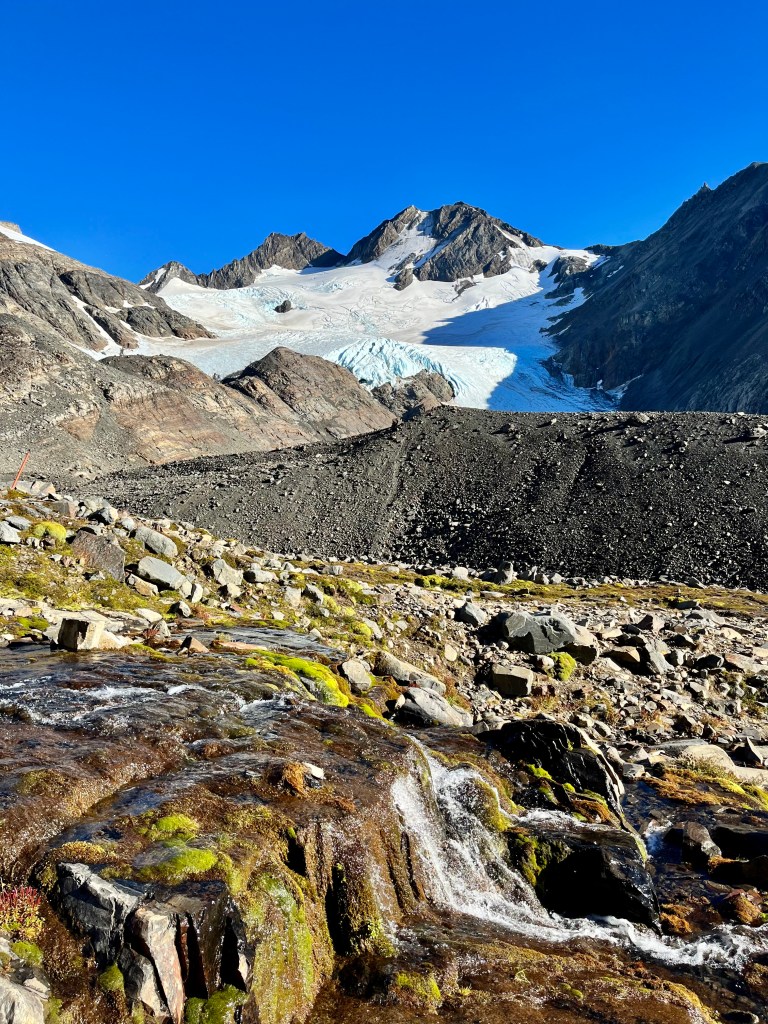
I am sitting at the base of the Los Perros Glacier. An icy green lake ripples at my feet, and a frigid breeze nips at my face. Behind me are giant rounded hills that wear lush forests at their sides, though their hilltops are grey and bald. At least, that means I have a clear view of the numerous waterfalls as they spill into the forests below.
Today’s hike was level and pleasant, lasting a little over nine miles, but I heard that tomorrow’s would be brutal. It would supposedly take six hours to get from the Los Perros campsite to the John Gardner Pass then another four hours to make it to camp. Considering the map listed it as a 12ish-mile day, the terrain must be aggressive. At least, it is only 2:30 pm right now. There is plenty of time to be off my feet once I get to camp, which is less than a few hundred feet away.
I wish I could camp here, though. I have never seen a glacier this close, and it blows my mind that I am the only person at this lake. It is just me, a tiny human, and a giant, gentle ice monster. Her millions of years of existence versus my 26. She is massive, baby blue, and crumbling before me. I just saw a piece fall off in a thunderous show of both power and vulnerability. Waterfalls spurted from her walls of ice until she seemed to piece herself back together. After a chorus of loud cracks and howls, it was quiet again. She was still there, in all her glory, exactly where she had rested for millions of years. Her crumbling made her even more impressive.
Oh, how much we can learn from one of the wisest of God’s creations, our sister, the gentle ice monster! The longer I sat, the more I felt that I was not the only living thing at that lake. Every blade of grass, every rock, every tree, every drop of water, and every piece of that glacier was created with the same divine energy that created me. All in the image and likeness of God in various, perfect forms, even in their worldly fragility.
The Los Perros Glacier was not simply a tourist attraction. She was a host who welcomed us into her home. She lives on our timeline, and she is just as vulnerable and finite as we are. But even in that vulnerability, she remains beautiful, mighty, and divine…just like you.
Hike Info:
Campamiento Dickson to Campamiento Los Perros
Length: 11.6 km (7.2 miles).
Elevation Gain: 591 m (1939 ft.)
Terrain: Dirt, small loose rocks during the final ascent
Other Notes: Plenty of tree cover! Even though it’s an easier day, don’t take too long to get to Los Perros Campground. The next day will kick your butt and you’ll need all the rest you can get!
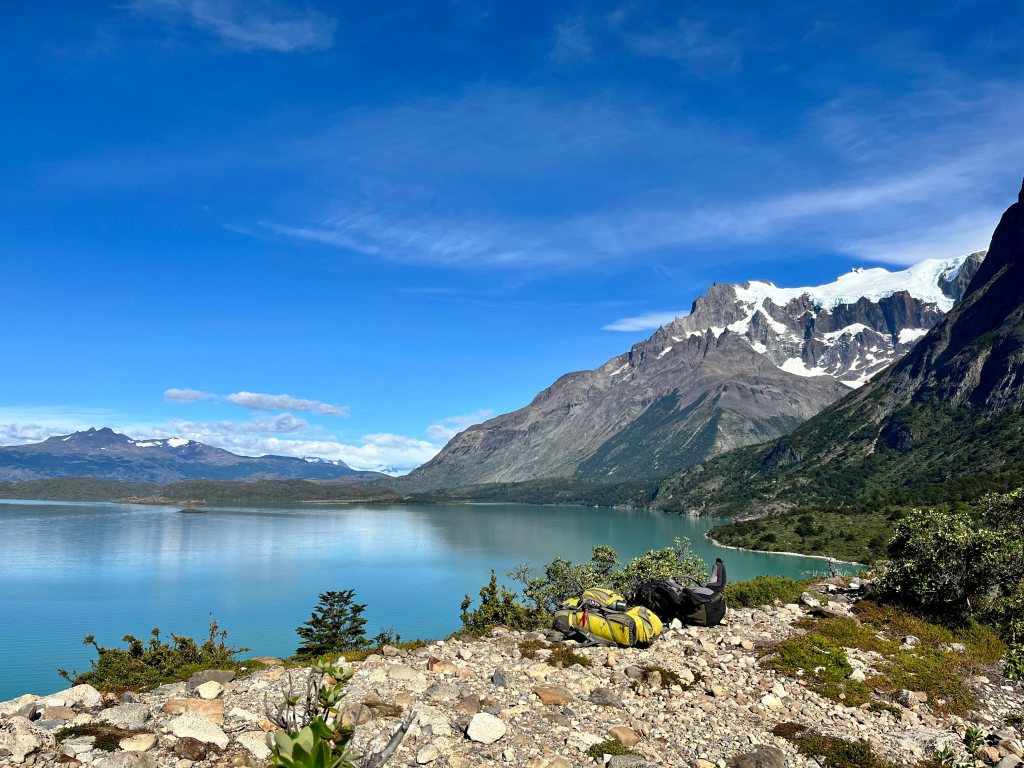
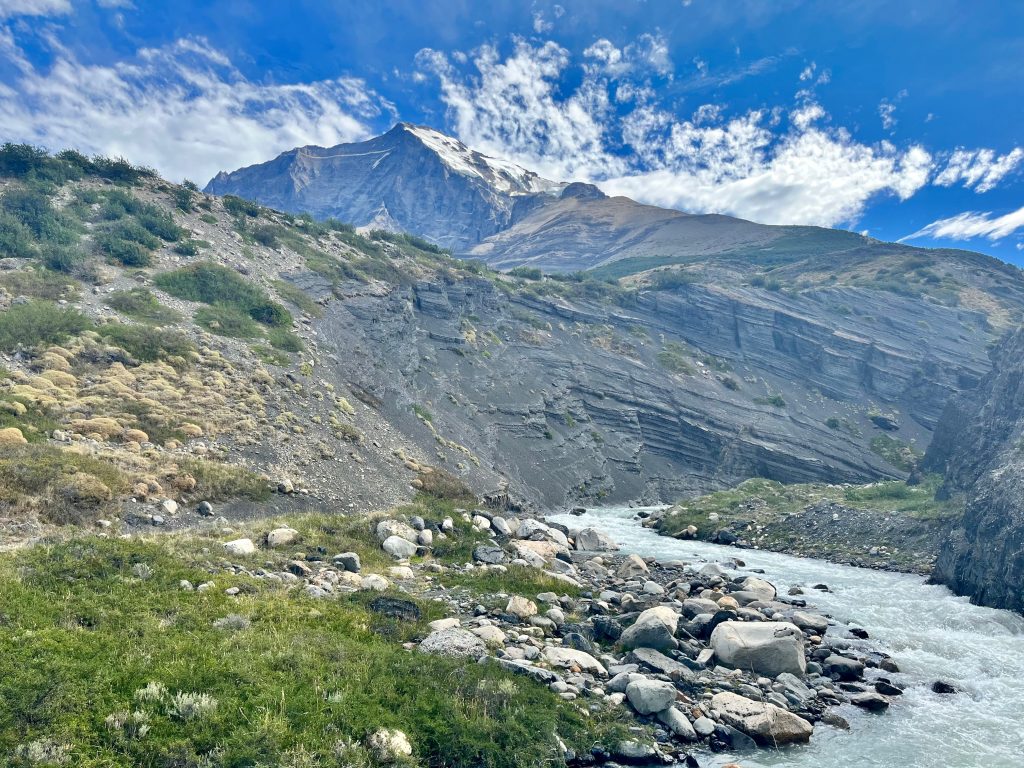
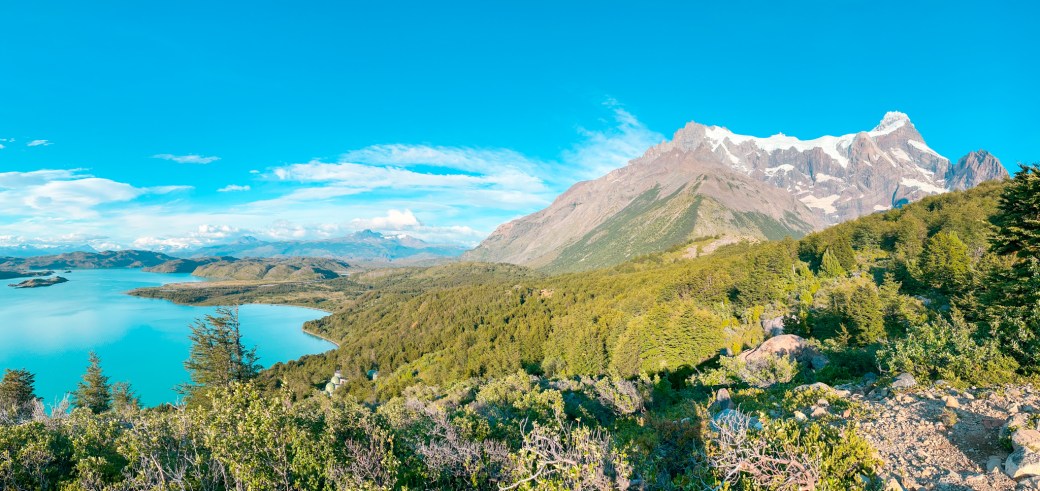
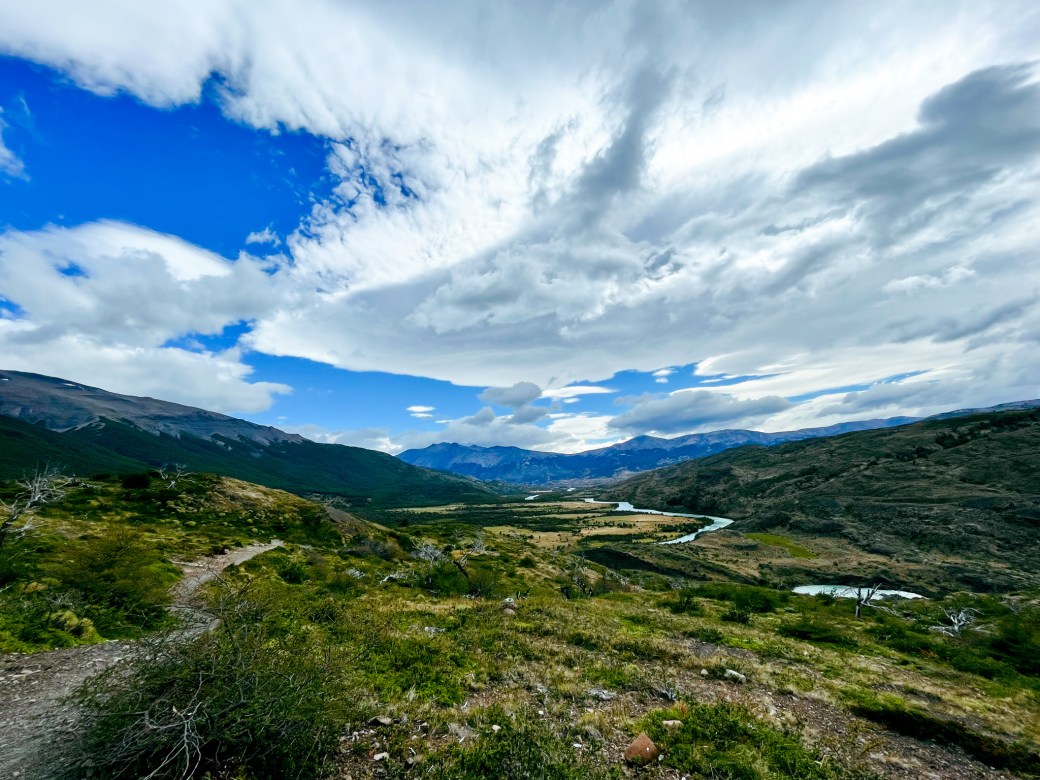
Other breathtaking views from the hike between Campamiento Dickson and Campamiento Los Perros!
I woke up to a flooded tent. Well, “woke up” would imply that I slept. The intense wind, pouring rain, cold temps, and constant need to pee resulted in a restless first night. Also, I forgot my tent pegs, so I had to line my tent with rocks. All night I watched the wind thrash my tent around, praying the rocks would hold.
I stayed behind to mop my tent with my only towel and wring out my damp clothes while my new friends hit the trail. They waved goodbye to me apologetically as they left. At 11 am, I figured I had done all I could and decided to start walking.
Within the hour, I was climbing up a steep, consistent incline of switchbacks that faced the campsite. It was frustrating not to see the starting point get farther as I trudged my way up. At the summit, I stopped to eat the last of my Oreos while watching a couple begin the incline far below.
The woman caught up to me quickly, and we snacked together while we watched her husband plop down on the side of the trail about halfway down.
“Pobrecito” Poor thing. She said.
“Animo!” You can do it! I yelled down to him.
We had a pleasant though choppy conversation. My Spanish is conversational, but the Chilean accent was so hard I might as well have been traveling in Italy. I understood almost nothing.
I wished her luck, and I continued walking.
The rest of the hike was flat, peaceful, and quiet. The only sounds came from the occasional babbling brook, rushing wind, woodpeckers, and hawks.
I walked, and walked, and walked. Hours passed without seeing another person, and though the view was beautiful, it was unchanging.
I sang songs to pass the time.
When couldn’t sing anymore, I practiced talking to myself in Spanish.
That didn’t last long.
So, I started trying to make up songs in Spanish. A challenge!
While trying to think of a rhyme for arbol I approached a wooden sign. It had information about the upcoming wetlands and a map with the distances scratched off.
“Pumas and wolves rely on these wetlands you are about to enter. Stay still and see if you can hear them,” it read in Spanish. Perfecto. I thought.
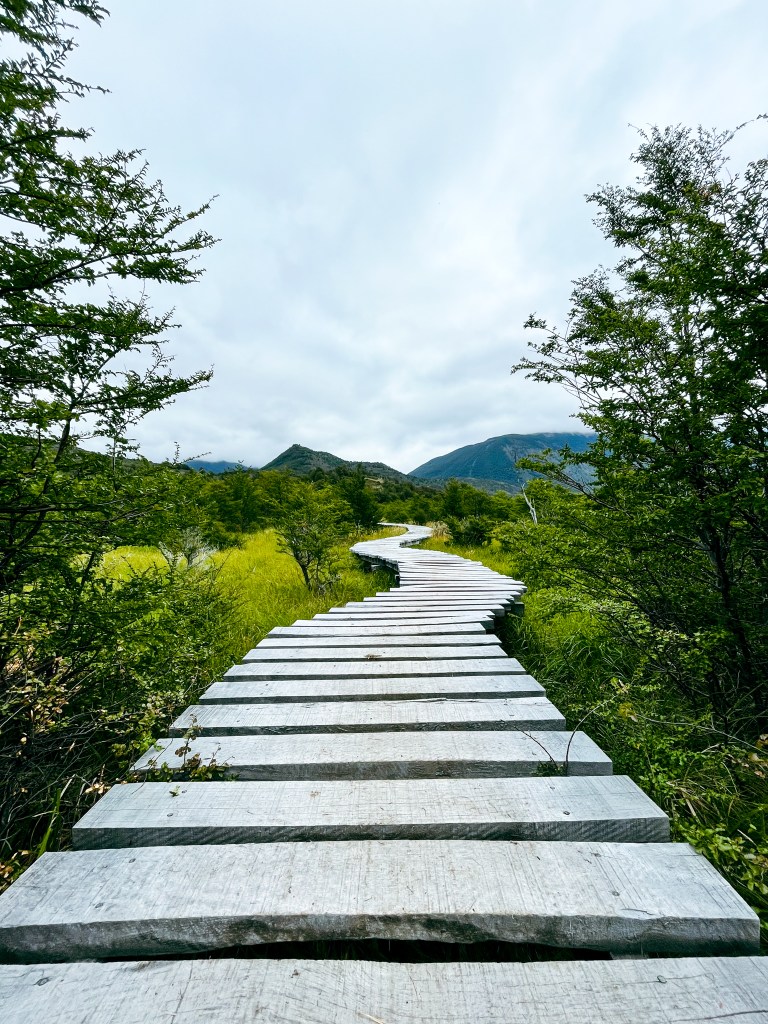
A wooden boardwalk replaced the dirt trail as I walked over the wetlands. It was magical, and it took my mind off my solitude. Unfortunately, that didn’t last long. The magical boardwalk and wetlands ended, and another dirt trail began. I was back to the same unchanging, grassy landscape. I did not know how much longer until the campsite, and there was no signage of how much I completed. I wasn’t tired nor frightened for my safety, but for some reason, I felt anxious.
I was walking through an open plain when the trail dipped deeper than the surrounding grassland, so I felt like I was walking in a trench. Around me were miles of a vast, empty, grassy expanse, and I was alone in it. The anxiety intensified, making my stomach queasy, and then it bubbled to the surface. I started to cry. I knelt and sank lower into the ground, threw off my backpack, and I cried even harder. I miss my mom. I said it out loud.
It was like that part of Wild where Cheryl Strayed saw a fox in the snow, yelled in an attempt to scare it away, and ended up calling out for her also cancer-stricken and deceased mom. I understand how she felt.
Memories of laying beside my mom in her hospital bed holding her hand while she wept. Or cooking meals for my grandpa while organizing my mom’s medication while entertaining visitors. Or removing the IV that kept her alive though in excruciating pain. Or being told, “stop saying you’re young. It’s hard on everybody” when I expressed that I was 26, motherless and tired.
These memories weighed heavy, but they were nothing compared to how painful they were in real-time.
Oddly enough, this last thought made me feel better.
These memories are simply that: memories. Still shitty and still heavy, but there is a growing distance between them and me. The doctors’ appointments, the grocery shopping, the nursing, the cooking, the funeral planning, the cleaning, the lawyer/bank meetings…everything was in the past. Being responsible for managing my mom’s pain while listening to her beg God to take her. It was hell, and now it is over. I am now responsible for my own pain management, for nursing my own mental and spiritual wounds.
I used the sides of the trench to stand up. I hoisted my 30lb backpack back onto my shoulders and walked confidently into the expanse without bothering to wipe the tears from my face.
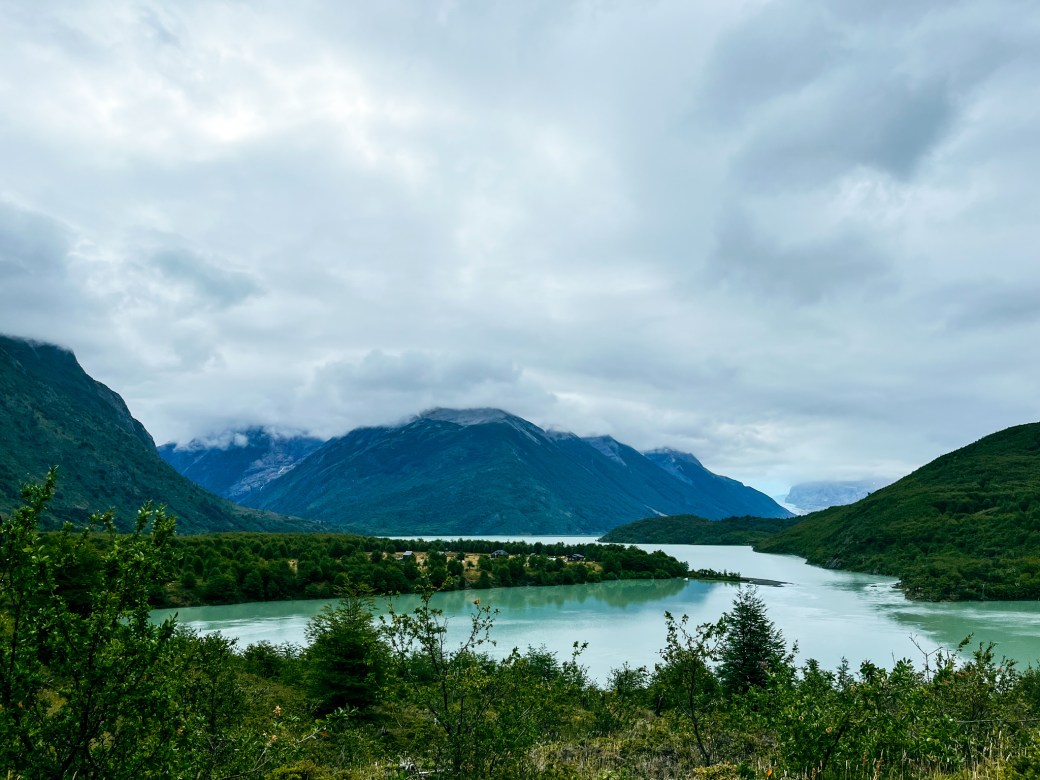
After two-ish more hours, I looked down into a valley and saw the campsite beside a massive green lake. Mountains with baby blue glaciers set the backdrop to this dreamy, rainy, overcast scene. I hiked down with excitement and set up my tent by the water. I heard two friends call my name, and I smiled as they walked over to greet me. “You made it! Also, we found these on the trail!”
One of them held out his hand and in it were two crooked, rusty, old tent pegs.
“Now maybe you can get some sleep tonight!”
I laughed, used a rock to happily hammer my new pegs into the ground, and then gathered with the rest of my friends for dinner.
Hike Info
Length: 19 km (11.8 miles). Elevation Gain: 730 m (2395 ft.) Terrain: Easy dirt trails even during the steep ascent. For about an hour after the initial ascent, you walk on the side of a mountain that is exposed but felt very safe. Winds might change the experience. Loose rocks on the final, steep descent to Campsite Dickson. Other Notes: Do not attempt if you do not have a reservation at the Dickson campsite! The rangers will send you back!!!
My hostel was bustling with excited travelers, gathered together talking about the next day’s big hike. They all met each other for the first time that night, and I wondered how they could easily make friends. I was sitting awkwardly in the back, reorganizing the contents of my backpack, feeling hyperconscious of my every move. I was doing the same hike as they were. I could have joined in, but my debilitating social anxiety made it impossible.
Throughout my childhood and even into college, my anxiety impaired basic living. As a child, asking for a to-go bag at a restaurant had me pacing back and forth for 15 minutes until my mom finally used her signature stare to get me to ask. Sophomore year of college, something shifted. I believe it was a combination of studying abroad, a supportive relationship, and a joyful roommate situation that resulted in a confidence boost and noticeable maturation. I thought I was past the crippling anxiety, but every so often, it returns.
Instead of worrying about it further, I decided to go to bed. I had to wake up at 5 am anyway.
The next morning I hoisted my monster backpack onto my shoulders and felt a wave of worry. It felt heavy, and I wasn’t even walking yet! I removed a few food items in hopes that it would lighten the load then made my way to the bus station.
The bus stopped at Laguna Amarga, where they checked our reservations.
“What trek are you doing?” The park ranger asked me in English.
“The O-Circuit,” I responded.
“How many in your party?”
“Just me.”
The ranger looked up from his clipboard, said “wow,” and told me to get on the green bus in the corner.
I followed his directions and found a seat. After some time longer, we arrived at the Centro de Bienvenido, where the various workers went through my paperwork and finally pointed me to the trailhead.
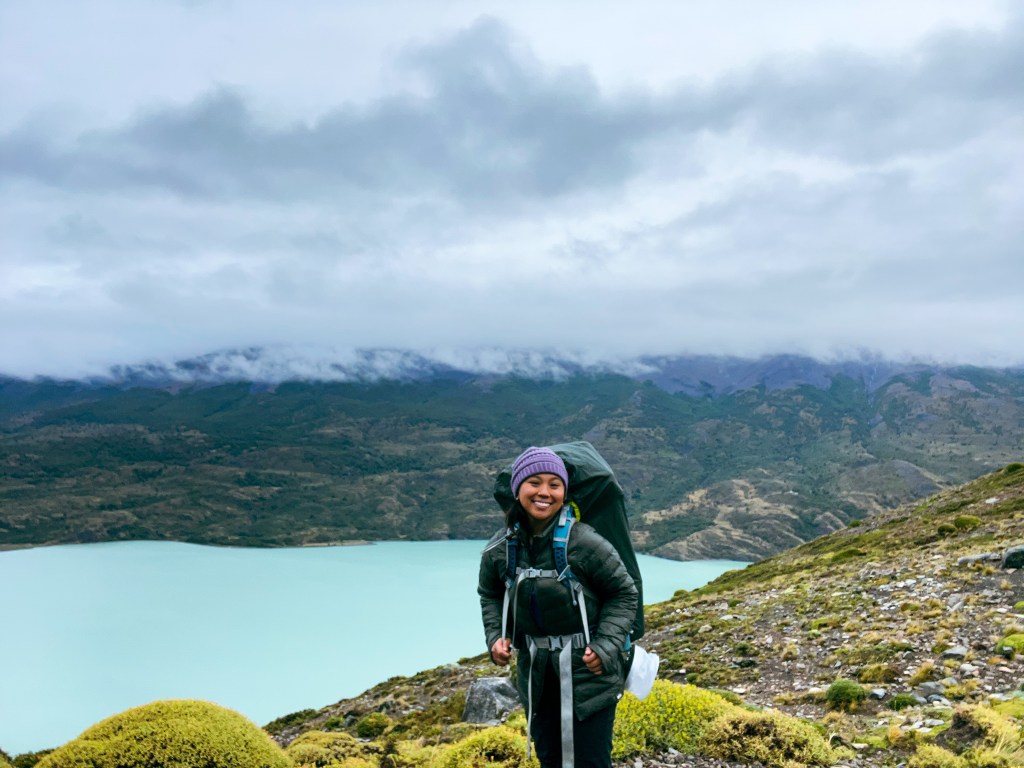
At this point, it was 9:30 am. I looked out, and a massive mountain with wispy clouds at its summit and a sparkling white glacier in its valley stood before me. I asked a man to take my photo before finally stepping onto the trail.
As I took the first steps towards the mountain, my stomach filled with butterflies, and I smiled big. Holy shit! I am hiking in Patagonia! For a moment, my backpack did not feel heavy even though the trail was steadily rising in elevation. I felt ecstatic! If I could have jumped for joy, I would have.
El Centro de Bienvenido to Campamiento Serón (Campsite #1) was 9.5 miles point-to-point with 1,000 ft of elevation gain and 860 feet of elevation loss.
It was a beautiful introduction to the Patagonian backcountry. Forests of Lenga trees, viewpoints of healthy rivers, and distant snowy peaks. At times, strong winds forced me to stop and squat to keep my balance.
At noon I realized that I was less than two miles away from the campsite, and I was a little surprised at how easy it was. So, I stopped to walk through a small river while snacking on some Oreos. Two young, sun-kissed backpackers headed in the opposite direction saw me and smiled.
“Fresca!” I said, smiling back.
“Uhh, sorry, we don’t speak Spanish!” They responded apologetically in English, but not American.
“Oh. I was saying that it’s cold, but it feels great! I recommend coming in.”
They looked at each other. “Ok!”
They slipped off their shoes and walked into the river with me. They were two men in their twenties who recently finished their mandatory service in the Israeli military. Now they were celebrating their freedom by hitchhiking and camping throughout South America. They also mentioned that the Torres del Paine trails were a little too easy for their liking.
“There’s too much bureaucracy! How can you enjoy nature this way? We went camping in Tierra del Fuego. Now THAT was a backpacking trip. It was wild. When you’re done here, let us know if you want to go on a real adventure.”
Part of me believes they were a little bitter since they were turned away at the campsite for lacking a reservation, but anyway, after 30 minutes of laughing and talking, it was time to part ways. One was headed to Stanford in the fall, so maybe we would see each other in California. The other would be a park ranger in Israel. He invited me to visit. Who knows if it was an empty gesture, but I would like to think it was genuine.
I thought about connecting with them after the O-Circuit, but I wanted to see if I could even complete this trek before attempting a “real adventure.” I slipped my shoes back on and walked the final few miles to the campsite feeling euphoric when I finally arrived.
After checking in at the cabin, I sat on its front steps to take it all in.
“Oh, you’re American!” said a young woman jauntily. (She said, “hola,” to me on the trail about an hour before this moment.)
“I figured you were American when I saw the REI tent, and now I just saw your passport. Oh, me? I’m not American. I’m Canadian!” Although I thought the hike was easy-ish, I was still tired. She, on the other hand, was fresh and energetic.
“Want to look for a spot together?” she asked. I agreed, and we talked while we shopped for flat plots of land. We finally settled on a space beside a green tent. Two Dutchmen emerged from that tent, smiling and handsome.
“Looks like we’re neighbors!” They exclaimed as they helped us set up our tents in the blustering wind.
Next thing you know, all of us were gathered together, along with a few other people, at a table. We talked, laughed, reviewed travel plans, and shared our excitement. At that moment, I was ten-ish miles into the Patagonian backcountry swapping travel stories with a group of international strangers, feeling free. The anxiety from the night before felt like a lifetime away.
And it was only day one.
Hiking Info
Centro de Bienvenido to Campamiento Serón
Length: 14.3 km (8.8 miles). Elevation Gain: 304.8 m (1,000 ft.) Terrain: Easy dirt trails. Splits between horse trails and hiking trails. Horse trails are rougher in condition, so don’t go on those. When descending into the valley, the terrain can get slippery. Can be muddy throughout. Other Notes: Trail is incredibly well-marked. A bit of the hike is beneath large trees but eventually opens up to large open fields and high viewpoints into the valley. High winds and rain are common.
I’ve been in Chile for a little over a week now, slowly working my way south from Santiago towards Patagonia where I am trekking the 85-mile O Circuit in Torres del Paine National Park. (I heard that 85 miles are just the straight-shot distances between campsites and not the actual length of the trails!) After six nights in Santiago and two nights in Punta Arenas, I have arrived at Puerto Natales, my last stop. Tomorrow morning I’ll take a bus to the trailhead and begin my trek. As the hike looms closer, I’m trying to channel my inner Cheryl Strayed in Wild, or Elizabeth Gilbert in Eat, Pray, Love. Both women were tangled in messy life situations until they carved their way out by physically removing themselves from the mess. Sometimes, all you need is some distance to put things into perspective. Sometimes, all you need is simply to worry about the next step.
View from Cerro Santa Lucía in Santaigo.
With the many logistical hurdles of this trip, taking steps one at a time is the only way I stay sane. To quickly recap all I’ve been through up till now, I spent a week in Santiago eating Nutella and backlogging writing for work. Afterward, I took a flight to Punta Arenas, a small town (but largest in Patagonia) in the southernmost part of the continent, and stayed there for two nights. I left on a bus this morning for Puerto Natales. Each of those steps required many little ones. Additionally, as a solo female traveler, I’m constantly vigilant yet simultaneously making sure I enjoy myself.
Admiring the awesome bike lanes in Punta Arenas.
The whole experience is a challenge, privilege, joy, and blessing. It is messy and sometimes scary and tiring, but worth it. Maybe that is why travel is the means of healing for so many book and movie characters. It mimics all the ups and downs of life and teaches you that the whole experience can be beautiful. Take this afternoon as an example.
I reserved a bed at a gorgeously unique adobe-like hostal. The only issue (that initially began as a super cool idea) was that it was up in the countryside hills and far from the city center. Not too bad, but there were only two roads to get there. Road #1 had two aggressive, sometimes violent, large guard dogs. They are chained 50% of the time. Road #2 had four similarly large dogs that only act aggressively. They are never chained, but will most likely not lunge. Getting to the hostal was hard enough without GPS, but sprinting from dogs was a bonus. Unfortunately, after settling into my hostal, I needed to leave again to buy groceries for my trek.
Heading to my hostal in Puerto Natales.
“Tengo miedo.” I’m scared. I laughed nervously.
“Yeah, they’re scary, huh? All you need to do is stand your ground and say, ‘FUERA!’” The young woman who worked at the hostal responded to me in English while leaning against the front desk. She had a partly shaved head, purple highlights, and avant-garde tattoos.
It was getting late, and I needed to go. The woman gave me a thumbs up and a “buenos suerte” as I walked out the door. I nervously paced outside for 15 minutes before finally walking down road #2.
I rounded the corner and thought, “You are Walter Mitty getting on that helicopter in Greenland. You are Cheryl Strayed traversing the PCT trail buried in icy snow. You are brave!”
The dogs lay curled up on the side of the road. “Cute,” I effortfully thought while adrenaline heated my body, urging me to run. The good news was that the dogs were sleeping deeply enough that I could quickly walk around them, delaying my opportunity to face them, at least until I had to return.
After stocking up on all my meals for the week, I began the long walk back, hoping the dogs were still asleep. “You are brave!” I repeated in my mind as I left the town center, as I crossed the stream, and as I made my way up the hills towards my hostal.
I walked alone, up the dirt path, between tall yellow grass. The snowy Patagonia mountains were visible in the distance. Colorful homes and a glacier-blue lake painted the foreground of my panoramic view. As I looked out in awe, two dogs stepped out of the grass and onto the road before me. My eyes widened. Tails in the air, they barked and bounded towards me.
“YOU ARE A BRAVE WOMAN!” I screamed internally. My heart was pounding!
I took out the baguette from my grocery bag and swung it like a sword. “FUERA!” I said!
Weird, but it worked! They continued to bark but they stopped running. As I walked through, still swinging my baguette, the dogs moved to the side and barked until my back was towards them.
Heart still pounding, I speed-walked into the hostal and plopped into a chair. The woman with purple hair asked how it went, and I gave her the story. She laughed and said she was proud.
The dog experience may not seem like a big deal, especially if you live in an area where fierce dogs roam free, but hey you gotta cut me some slack. I was born and raised in Los Angeles, where we’ve got 99 problems, but stray dogs ain’t one. Regardless, having to face them was unexpected, scary, and undesirable BUT I believe I am a little better because of it.
–
Anyway, see ya in a week. Torres del Paine, here I come.
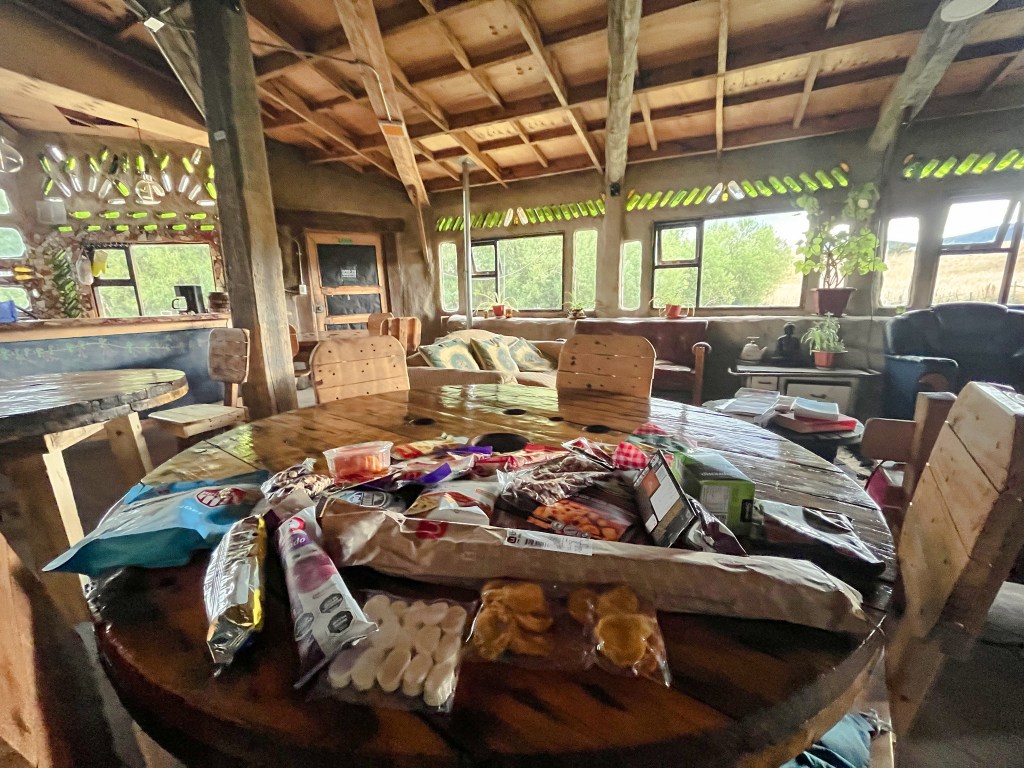
Food for the trek! The selection in town was much smaller than I anticipated, but it worked out!
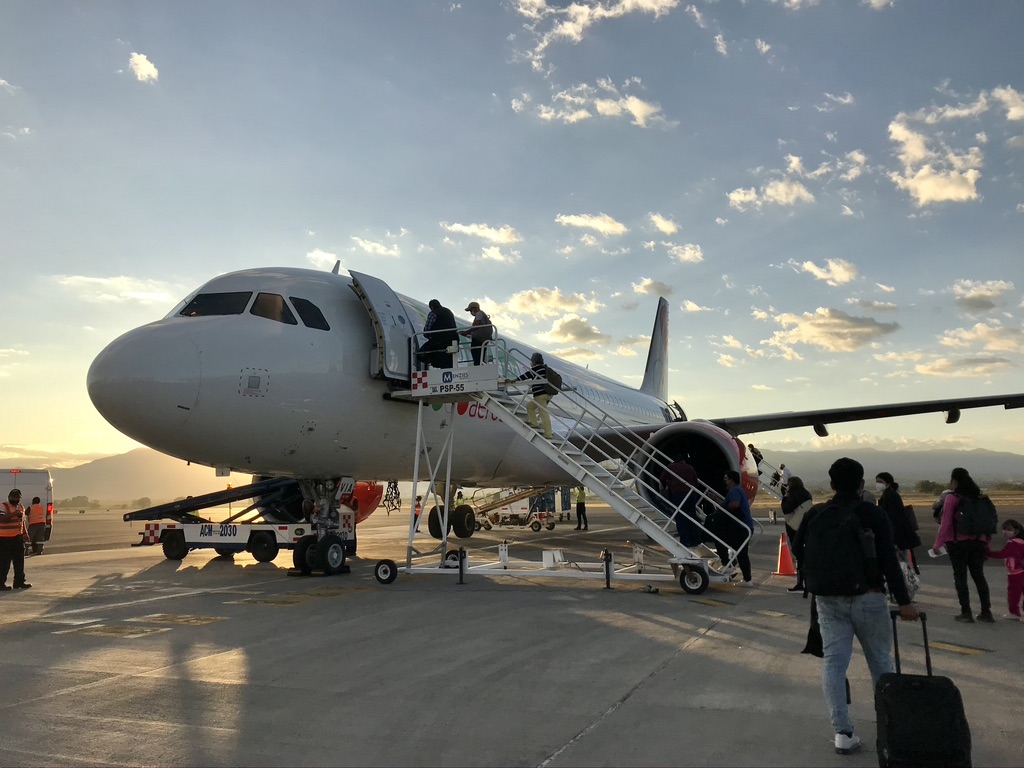
At 7 pm I walked off the plane’s metal staircase and onward into Oaxaca, México, my first solo trip. It was already dark, but I could see the flicker of city lights in the distance and smell a crisp air that only comes with an abundance of trees. My 25-pound backpack buckled over my waist, cinching it a little too tight. Months of sitting by hospital beds and stress eating led to a bit of sluggishness in my step despite my excitement at finally arriving in Oaxaca, the Mexican state known for its cultural and indigenous legacy.
The real reason I visited Oaxaca was that I wanted to light a candle on my mom’s birthday at a church she often hinted at wanting to see. And so, I made a day of it. I spent my first day in Mexico crafting my mom’s would-have-been 57th birthday extravaganza, concluding with Mass and candle lighting at the cathedral in the Zócalo. (The church she actually wanted to visit, Templo de Santo Domingo de Guzmán, was closed that day.)
She never was a big birthday party person. She always wanted to keep it intimate with little fuss, but she often complied when pressured to aggrandize. Even on her birthday, she gave.
Mom’s 50th Birthday
This time around, the pressure was on. I brought her spirit to Mexico, and we were going all out. I checked into my Airbnb, and we were off.
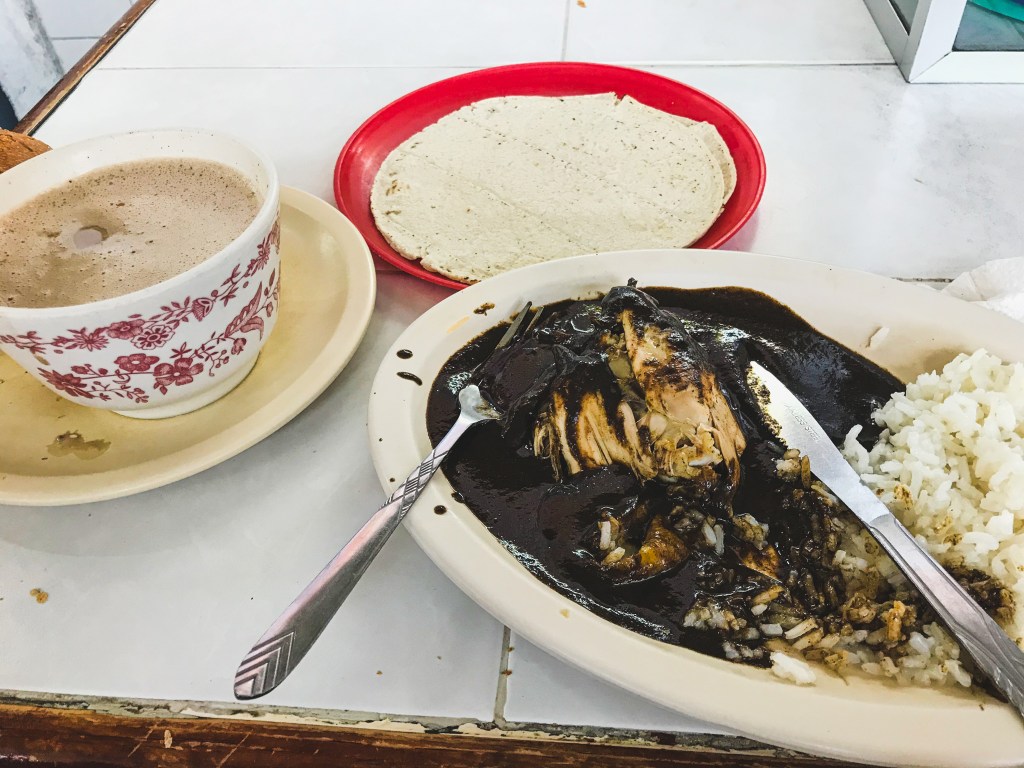
In search of the birthday feast, I followed my nose through the city until I meandered into a narrow, smokey mess hall bordered with food stands draped with hanging meat. Lines of people excitedly called me to look at their menus. I walked through politely declining each offer until I was almost jogging away to avoid their persistence. Finally, I settled on a stand managed by a woman and her toddler grandson. I leaned a photo of my mom and me against the napkin holder while she prepared my mole negro.
The chicken was moist beneath the black, spiced, unsweetened chocolate sauce, while the white rice balanced the otherwise complex flavors on the plate. According to my surface-level research, mole, derived from the Nahuatl (naa·waa·tl) word “molli,” originated in pre-hispanic Mexico and was served during Aztec rituals. An indigenous dish that outlasted the Spanish should be revered, so I closed my eyes, gave thanks, and ate slowly.
Mole negro, tortillas hechas a mano, y tejate en el Mercado de 20 de Noviembre
Afterward, I went for a walk, like my mom and I did almost daily before work during the pandemic. Short, colorful buildings donned wrought-iron balconies, intricately carved doorframes, and last month’s Día de Muertos marigolds. Papeles picados hung over the stone streets where stray dogs laid prostrate in the heat, kids played with firecrackers, and men shined their shoes.
October’s Día de Muertos decorations
A bookstand caught my eye. I walked over and thought about buying a book to practice my Spanish when a wholesome-looking man around my age popped up from behind the stand and asked if I needed help.
“Estoy buscando un libro sobre Oaxaca.” I’m looking for a book about Oaxaca. I said confidently.
“¿De dónde vienes?” Where are you from? He replied. Ugh. This always happens.
“Los Estados Unidos. Los Ángeles,” I replied reluctantly.
“Por qué estas en Oaxaca?” Why are you in Oaxaca?
And the flood gates opened. I told him all about my mom, her sudden cancer diagnosis, my short stint as her hospice nurse, and her quick passing. It had been two months since she died, and now I’m in México, sola. Alone.
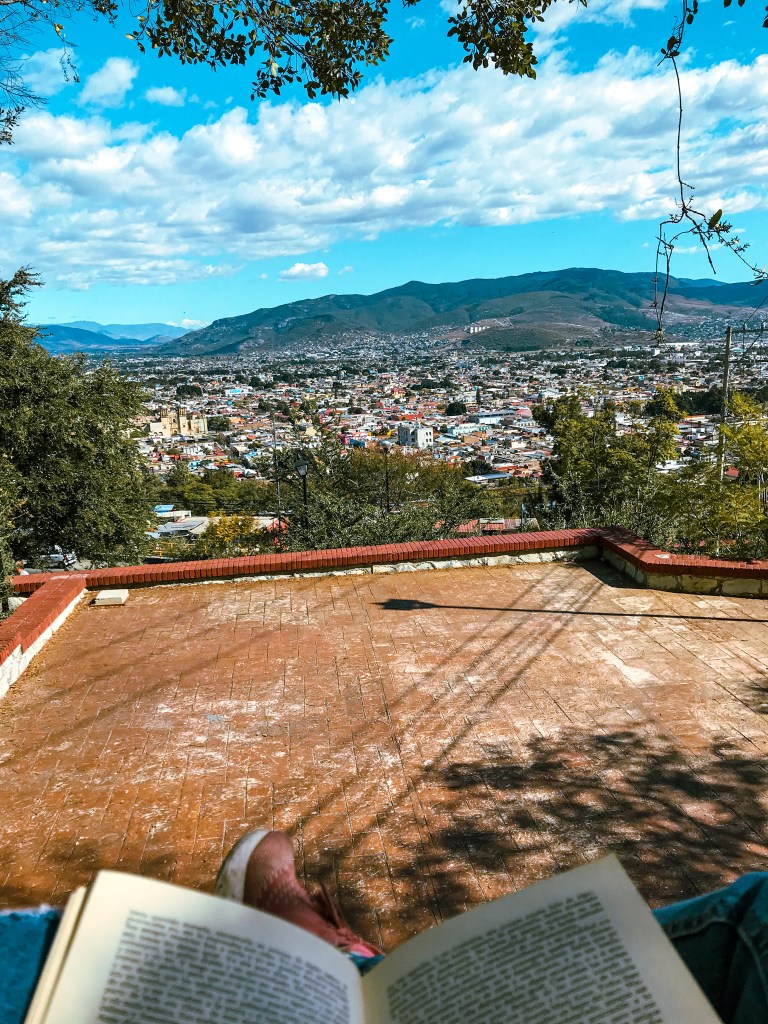
View from the Auditorio Guelaguetza
He looked me in the eye. Empathetically, he told me that his mom battled breast cancer for years and how awful it was. He expressed that he was sorry my mom had passed but was grateful her agony was relatively short. We looked at each other in comfortable silence for a moment before he turned around and gave me his book recommendations.
After talking a little more, I walked away with No Todos Los Hombres Son Romanticos, his WhatsApp number, and an invitation to grab a hot chocolate later that night. “Podemos practicar tú español,” he said. I never intended to meet with him, but the offer still felt nice, and today was my mom’s day anyway.
I read my new book on the steps of Auditorio Guelaguetza, high above the city center, before I headed back down to attend Mass at 5 pm.
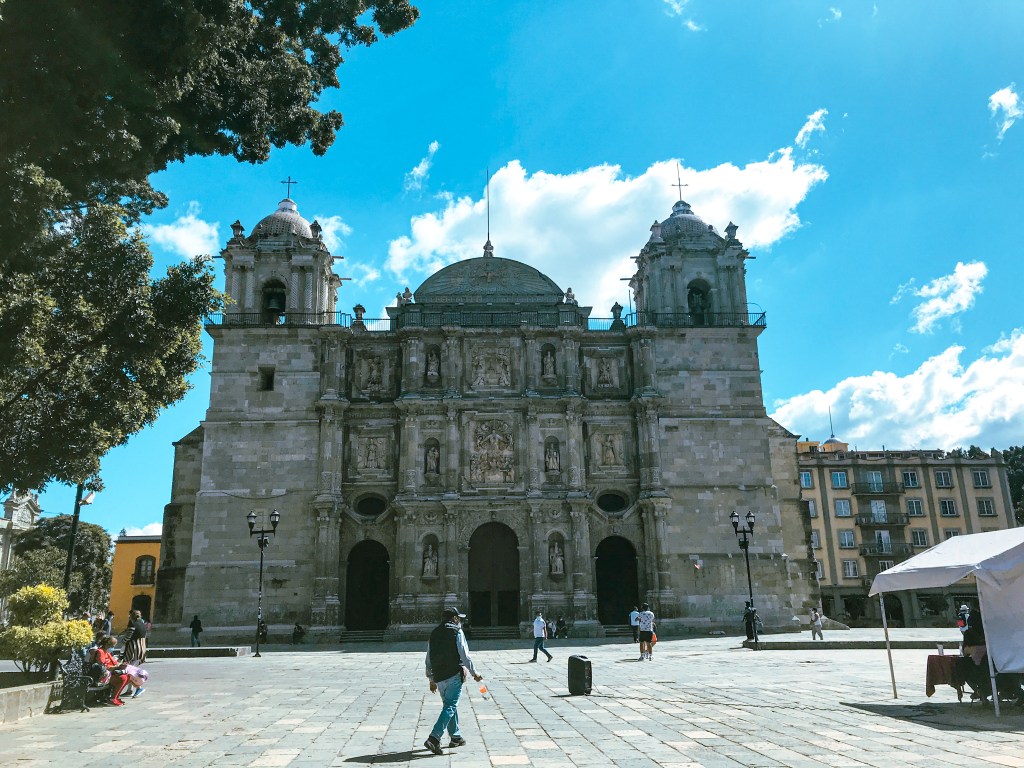
I made it to the Catedral Metropolitana just in time, impressed that I could navigate without GPS. The baroque church stood magnificently at the center of the Zócalo. Parishioners dressed in their Sunday best silently waited for Mass to start.
I grew up a practicing Catholic and attended all Catholic schools from Kindergarten through college. I even worked at a Catholic charity for three years after graduation. I loved the faith; however, I am aware and conflicted by the problematic past and present of the church. I blame humans. They ruin so many good things that I’m sure God isn’t happy with the church either. I thought about all this as I watched a woman dressed in indigenous vestments kneeling in the front row.
Catedral Metropolitana de Oaxaca
Mass went on, and I tried to get into a meditative state, but I was too preoccupied trying to translate. I eventually gave up and just thought of going to church with my mom. Every Sunday, we would walk from our house, sometimes run if we were late, and sit as close to the cutest baby as possible. Sometimes we would listen, and other times we would whisper ideas for breakfast during the Homily. It made Mass fun, and I still felt God’s presence.
The priest said his final prayer and exited the altar. The light that once poured through the stained glass windows was fading as evening set in, and I was ready to go to bed. I searched for a good place to light my candle and conclude the day, but there were endless altars with hundreds of candles. Finally, at the very back of the church was a statue of Mary, Mother of God. I walked up, looked at her face and outstretched arms, and I felt a wave of profound sadness.
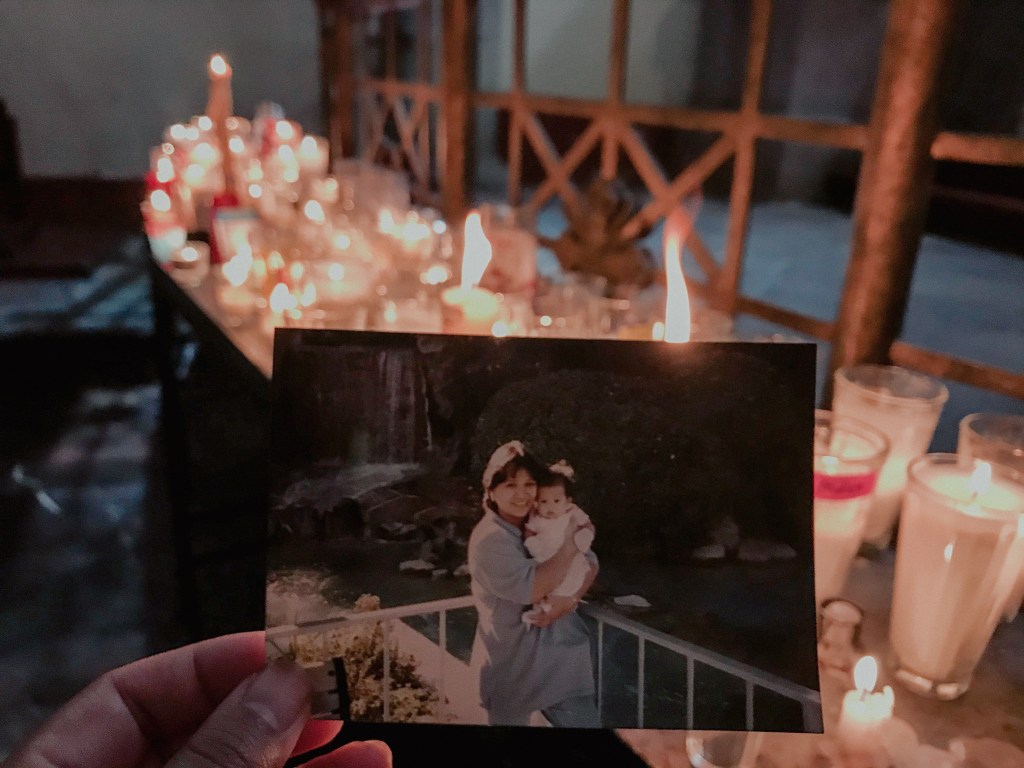
I felt the expansiveness of my mom’s absence for the first time since I stepped off that plane, and I cried, surrendered my sorrow to her, the Blessed Mother. I was alone in Mexico, but I felt alone in a much bigger way. I took out my mom’s photo and found a tiny unlit candle. I lifted the candle and used an existing flame to light it, then gently placed it back onto the table alongside hundreds of other candles.
I took a deep breath and walked back to my apartment, snuggled into bed, and went soundly to sleep.


























 Jess Outdoors
Leave a comment