Without Cursing the Earth Beneath Me

Patagonia Pt. 6

Campamiento Grey —> Campamiento Frances —> Campamiento Central
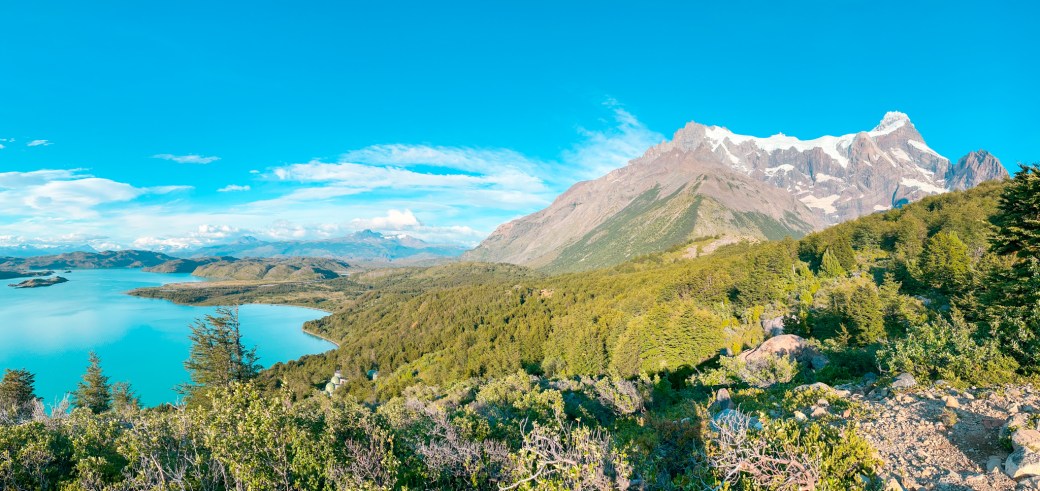
After hiking eight grueling hours under a beating sun from Campsite Grey to Campsite Frances, I had a Snickers, a pot of curry-flavored quinoa, and half a can of beer. The other half I spilled in my tent.

At this point, I accepted the sloppiness of my existence, like “showering” with a Neutrogena wet wipe or spit-launching dusty loogies without breaking my stride on the trail. Anyway, I thought about sleeping in the nude, but the bitter cold convinced me otherwise, so I slipped on my least dirt-crusted clothing and relished the warmth. That night I had the deepest sleep of my life. Cushy beds in Vegas Venetian Suites paled in comparison. Not that I experienced those too often.

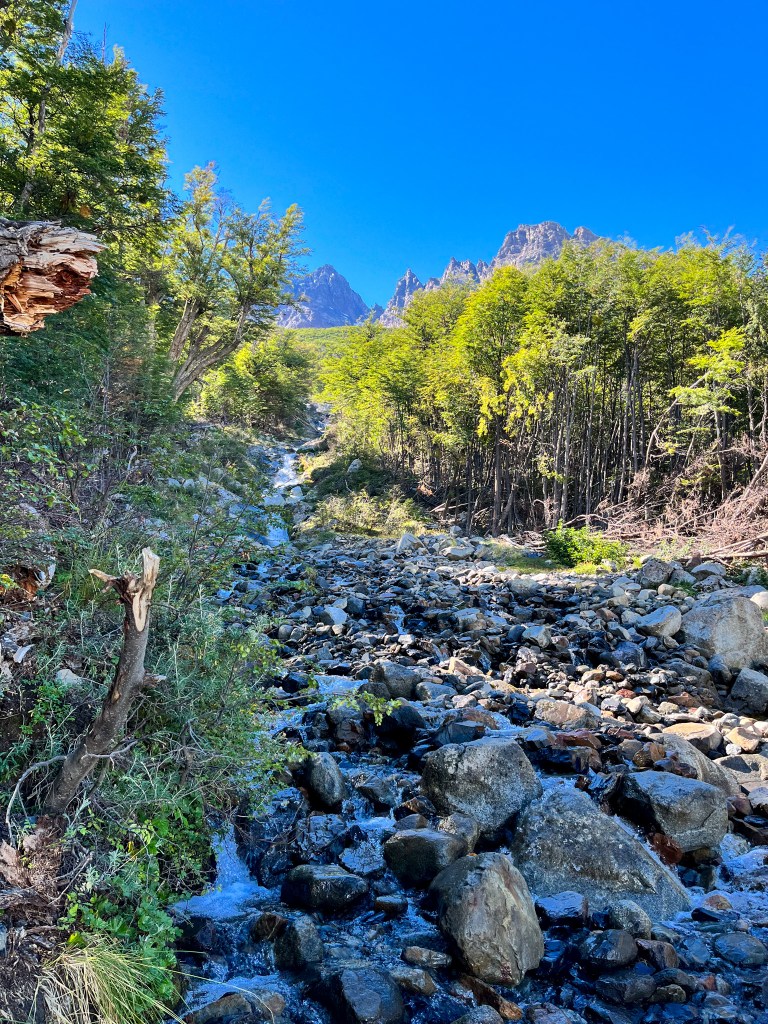
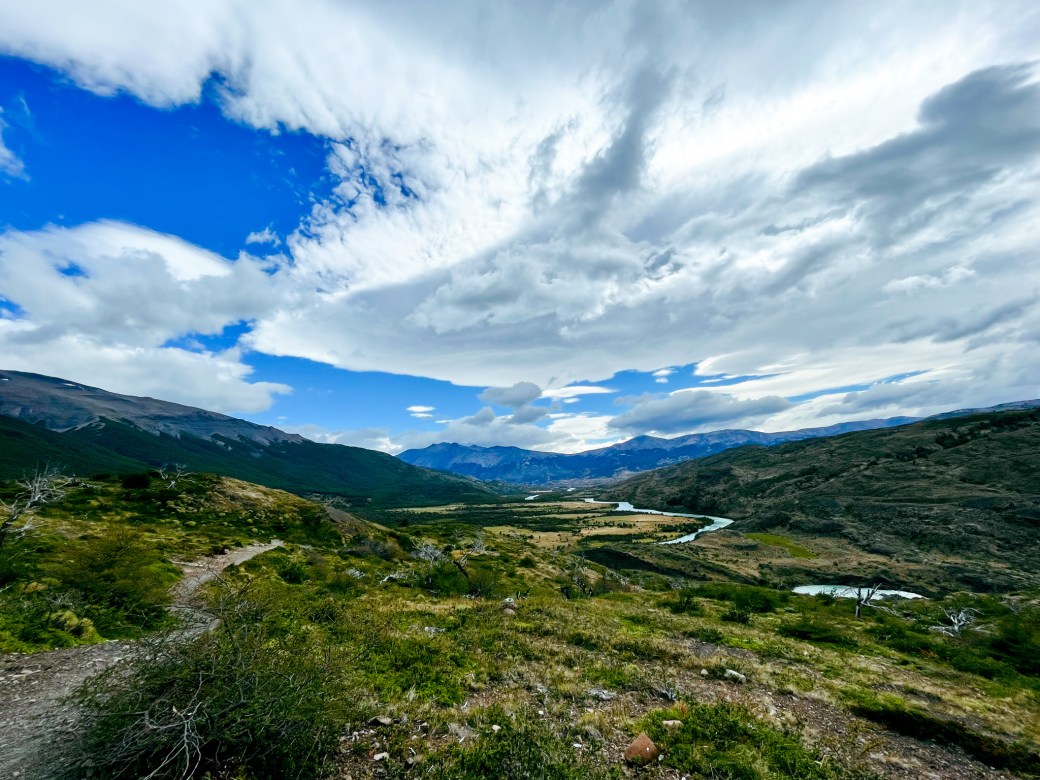
See that river? Yeah, that’s the trail.

I woke to the smell of my beer-soaked tent. Without complaint, my body sprung into the morning ritual. Within 30min of waking up, I was on the trail chomping on mouthfuls of peanuts as I marched.

I marveled at how my body had changed, even after just a week of backpacking. My lungs breathed deeper, my skin was smoother, and my thoughts were kinder. The weight of my backpack was less burdensome, and elevation gains no longer made my muscles scream like they used to. Now I can simply relish the view without cursing the earth beneath me.

During the last section of the 12ish-mile hike to Campsite Central, I met a new friend. This man would hike past me, then I would pass him, then he would pass me, and we did that for miles until eventually, we stopped to talk.

“Es hermoso, no?” He asked me in Spanish. He walked up behind me while I was admiring a nearby lake.

“Sí. Es ummm… lo siento mi español es muy malo, pero queiro practicar!” I wanted to say so much more about the lake, but I did not have the vocabulary.

“Oh don’t worry. I speak English. Where are you from? Also, yeah, let’s practice!”

He was a young, sweet Chilean man who spoke with intensity and passion. We walked a few miles together, switching between English and Spanish. We talked about Chilean history, people uprisings, feminism, and the environment. I learned more about Chilean bureaucracy than I ever thought I would.

I remember listening to him talk about hope as I gazed out onto the neverending trail. A cool breeze made the hot sun tolerable, and there was a satisfying crunch of dirt beneath our boots as we marched in matching strides. The dramatic metamorphic mountains, glaciers, and waterfalls were behind us as we ventured towards the Welcome Center, exactly where I started seven days before. I wondered how I would feel when I would eventually arrive. All the positive changes I mentioned came from living out in nature, but how would I fare back in the “real world?”

After a few hours together, my new friend decided to stop at a river to relax. I continued without him.

I crossed the last suspension bridge, pushed through one final steep elevation gain, and saw my final campsite. A wooden sign indicated that the Welcome Center was just up the road, but a hotel and parking lot already alerted me that I had returned.

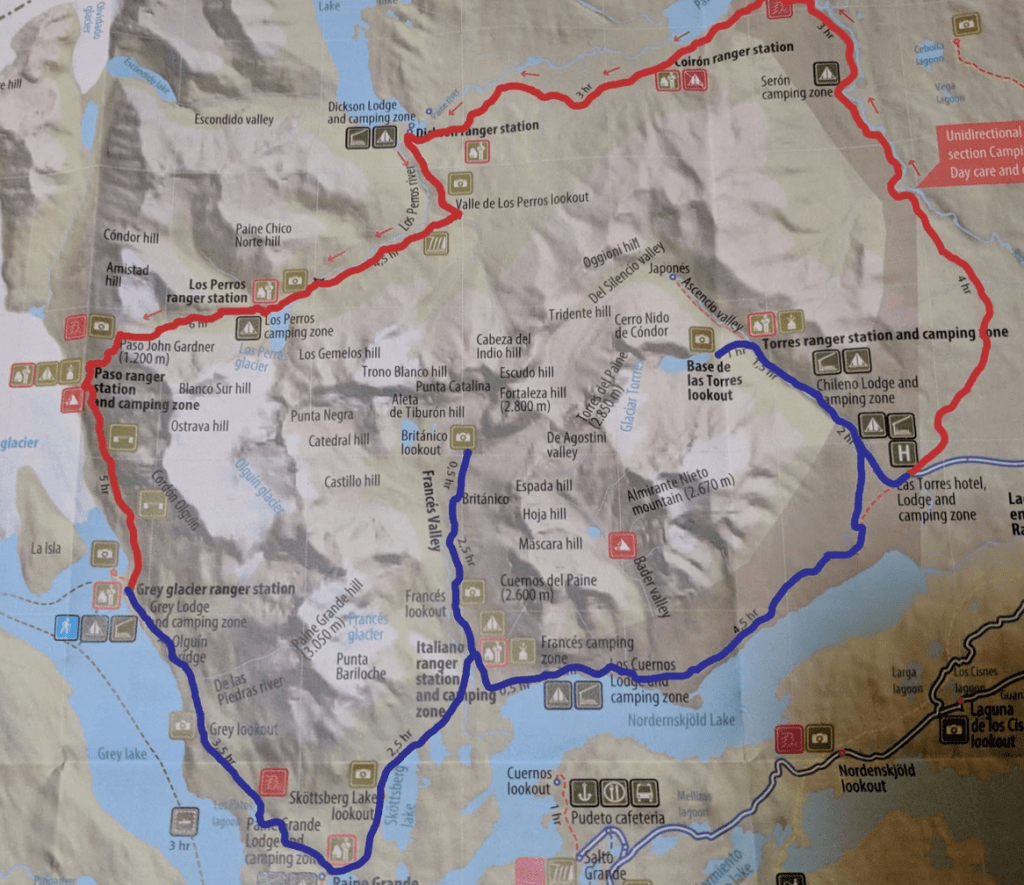
I stopped walking. My eyes spilled with joyful tears, and my stomach knotted with excitement. Seeing the hotel made me smile and laugh as I audibly whispered to myself, “Holy crap. I did it.” I completed the Torres del Paine O-Circuit! 80 miles in seven days. 30.1 miles in just the last two.* I arrived back exactly where I started, but I could not have felt more different.

With newfound energy, I set up my campsite swiftly, my hands working on automatic while I daydreamed about the next day, my last hike in the park, the grand finale: an 18-mile* round-trip trek to the base of Torres del Paine. At least I could leave my backpack at the campsite.

I walked to the little store to buy myself a coke and an hour of wifi. There, I bumped into my Texan friend (the man I hiked with for 11 hours over the John Garder Pass). He was sunburnt, dirty, and leaner, but he looked so happy. “I want to hear all about your last few days!” He said as we hugged.

He bought me another coke and one for himself. Rain began to pour as we excitedly recounted our adventures as the sun set on the distant Torres del Paine Towers, our final destination.

*On maps, the distances between campsites are written straight-shot, point-to-point. They don’t count the miles of switchbacks, loops, and bends that a person must hike between point A and point B. I’m basing my mileage on the data I got off my phone days after I finished the trek.

An Inch is a Cinch, but a Yard is Hard

Patagonia Pt. 5

Campamiento Los Perros to Glacier Grey

“Tomorrow, the hike will be around 13 miles but last 11-12 hours. It will start with a 6,400 ft incline until the John Gardner Pass, then about a 9000 ft descent that will last around two to three miles. It is STEEP. If you don’t have trekking poles, find a good stick. After that, you’ll have around five hours left before you reach the next campsite. I suggest an early start.”

The ranger briefed me on tomorrow’s hike to Glacier Grey, looking concerned that I was one of the last people to arrive at the Los Perros Campsite that afternoon. I reassured him that I spent a few hours writing by the glacier. I’m not such a slow hiker.

My cozy spot at Campamiento Los Perros

“No writing or reading tomorrow. Stop to take a quick photo, but then keep walking.”

I nodded, scavenged for a perfect walking stick, and snuggled into my sleeping bag before 8 pm.

I woke up pre-dawn the following morning, swallowed a handful of trail mix, and followed a group of other hikers up into the forest. They were faster than me. It was dark, and the already aggressively steep trail was covered with fallen branches. I lost the group within thirty minutes, and I lost the trail soon after.

I couldn’t hear anyone around me, and I couldn’t see anything beyond the glow of my headlamp.

“HOLA!?” I yelled.

Silence.

“HELLO?!?!”

Nothing.

My heart started to race while I speed-walked through the trees, scanning my surroundings for the trail. Even though I climbed in elevation, the forest was so thick I could not get a clear view of what was below.

I high-kneed my way over tall bushes across the mountainside, hoping I would run into someone. Worst case scenario, I would walk back down, and I was positive the campsite would be easy to find. I wasn’t in any real danger, I told myself.

I lowered my body into a narrow, dry riverbed, suppressing panic tears, when I heard, “Oh hey, Jessica!”

It was a Texan man I met on my first day in Torres del Paine National Park. He was trekking up the riverbed. I was on the trail!

“I’m glad I ran into you! I was told this hike can get pretty gnarly, so it’s best to do it with a buddy. Want to walk together?”

We started back at that lake!

I agreed, though my fear of getting lost was now replaced with a fear of holding a conversation with a stranger for possibly 11 hours. At least my mind was too wrapped up thinking of conversation topics that I paid less attention to the steepening incline until it was painstakingly impossible to ignore.

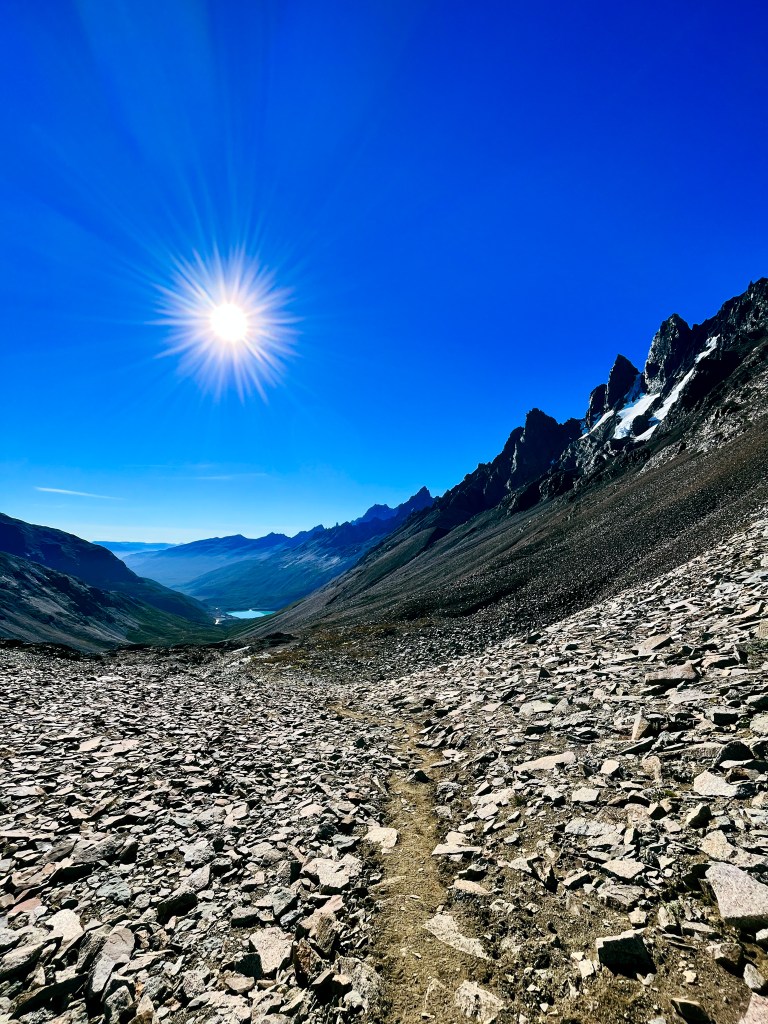
The trail left the forest and brought us into a clearing of loose rocks and draping glaciers as we ascended the pass. Orange metal poles jutted out of the earth indicating that the trail continued up as far as I could see. Teeny tiny backpackers ahead were slowly trudging up and behind a mountain. I hoped the incline ended there. (It didn’t.) Glacial runoff spilled from the direction we walked up, making the loose rocks even more slippery. Thank goodness it was a windless, sunny day. The trail could easily be a treacherous hike under worse conditions.

The conversation between my partner and I shrank into groans, numerous comments about burning calves/hamstrings/etc., and asking each other, “how much longer, you think?” As if either of us knew.

A wooden sign presented itself. My friend read it while I caught my breath, hands on my knees. “We’re about 1/5 of the way done, according to this map.”

Took a photo because I thought this was Glacier Grey. It wasn’t, but it was still spectacular!

Hours passed, and as magnificent as my surroundings were, I looked down at my feet as I walked. If I kept my head up and looked ahead, I would get discouraged, my heart would beat faster with overwhelm, and my body would ache more. So focusing solely on the next step was the only way I could convince my mind and body to keep moving.

“An inch is a cinch, but a yard is very, very hard,” My mom used to say.

I trudged on and on and on. Higher and higher and higher until…

“Jess, look up!” My friend said breathlessly.

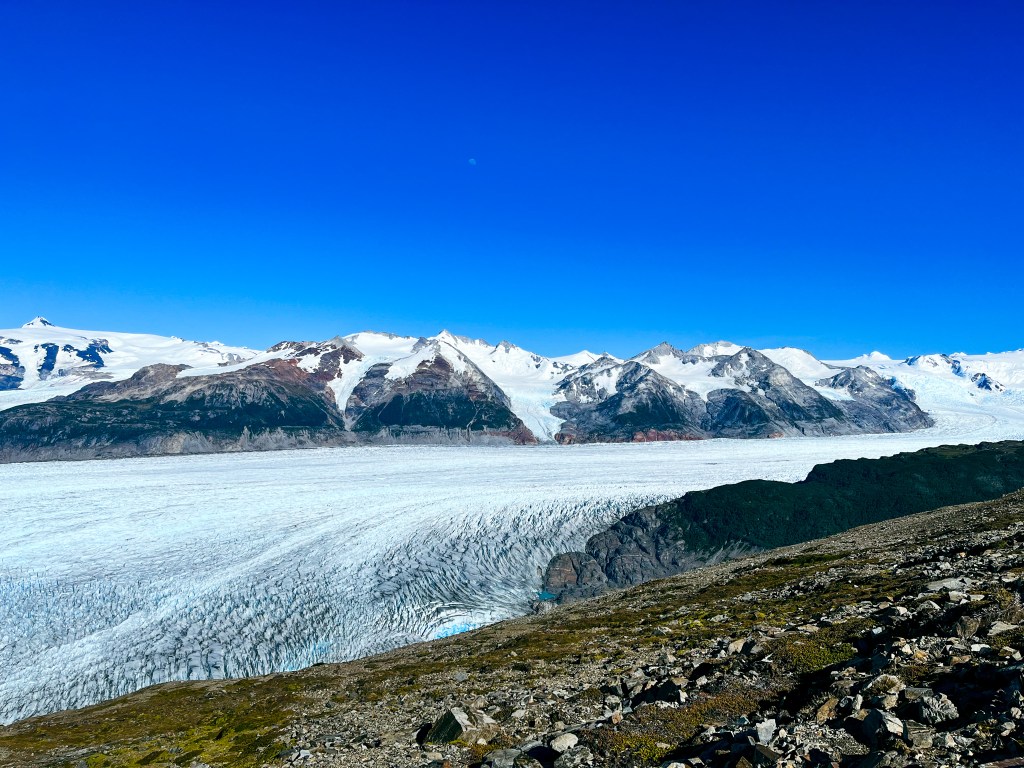
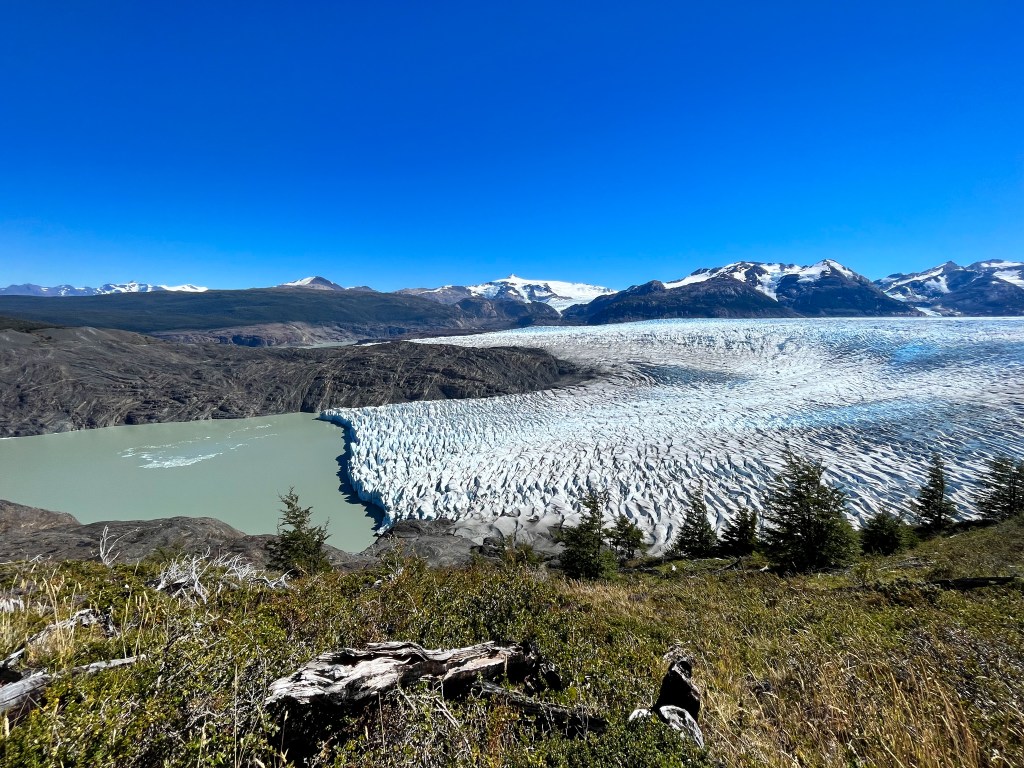
I looked up, and my jaw dropped. We reached the summit of the John Gardner Pass, and ahead of us was Glacier Grey. It expanded across my peripherals, and even when I turned my head, I couldn’t see where it ended. It was gigantic. The ice field spanned across the bases of six or seven mountains, and a luminous baby blue hue glistened in the valleys and caves within it. Distant, thunderous howls erupted from the mighty glacier as it calved in places I couldn’t see.

I took off my backpack and sat while my friend opened his one pack of M&Ms in celebration.

It was just us, our aching muscles, a frigid wind, a powerful silence, and a 100 sq. mi. glacier. I felt so small and insignificant but in a beautiful way. The experience commanded a shift in perspective. My anxieties, pain, joys, past, present, and future matter, but I realized how foolish it was to believe my reality ended there. True reality is shared, constantly shifting, and expanding. Even this thousand-year-old massive glacier is merely a speck in the universe. So what am I?

The universe is infinite. It is a reminder that life events are important, but in the grand scheme of things, the itty bitty moments that make up our lived experiences do not matter as much as we think they do. A failed business venture, a breakup, an embarrassing moment, and even the death of someone important. All that matters and is worthwhile to hold dear, but the possibilities to learn and live in life go beyond what we personally experience. We just need to be open to going beyond our ego to find it. Fear, suffering, and pain are even smaller specs in this universe, as is joy. And oddly enough, that makes me feel free.

After an excruciating six more hours (where I experienced the steepest descent of my experience as a hiker, multiple adrenaline-pumping suspension bridges, dangerously exposed ledges, and the worst knee pain of my young life), I reached the Glacier Grey Campsite.

I was too tired to eat, wash up, or secure my tent. I just stripped down, got into my sleeping bag, and slept soundly until morning.

Hike Info:

Campamiento Los Perros to Campamiento Grey

Length: 22 km (13.7 miles) Point-to-Point
Elevation Gain: 1,204 m (3,950 ft.)
Terrain: Dirt trail. Loose, sometimes slippery rocks. LOTS of mud.
Other Notes: Trekking poles are recommended! I definitely needed a hand on the steeper steps and out of deep mud. Most of the trek will have forest cover, but the hardest ascent up the pass will be completely exposed to the sun! I was lucky that it was sunny, but I heard winds and rain are common, so I 100% recommend finding a buddy if you’re backpacking alone. The views are 100% worth the pain! Also, I brought ibuprofen, and I was very happy I did.

More Photos from the Epic Hike!

Our Sister, the Ice Monster

Patagonia Pt. 4


Direct From the Journal: Torres del Paine “O” Circuit Day 3- Dickson to Los Perros

I am sitting at the base of the Los Perros Glacier. An icy green lake ripples at my feet, and a frigid breeze nips at my face. Behind me are giant rounded hills that wear lush forests at their sides, though their hilltops are grey and bald. At least, that means I have a clear view of the numerous waterfalls as they spill into the forests below.

Today’s hike was level and pleasant, lasting a little over nine miles, but I heard that tomorrow’s would be brutal. It would supposedly take six hours to get from the Los Perros campsite to the John Gardner Pass then another four hours to make it to camp. Considering the map listed it as a 12ish-mile day, the terrain must be aggressive. At least, it is only 2:30 pm right now. There is plenty of time to be off my feet once I get to camp, which is less than a few hundred feet away.

I wish I could camp here, though. I have never seen a glacier this close, and it blows my mind that I am the only person at this lake. It is just me, a tiny human, and a giant, gentle ice monster. Her millions of years of existence versus my 26. She is massive, baby blue, and crumbling before me. I just saw a piece fall off in a thunderous show of both power and vulnerability. Waterfalls spurted from her walls of ice until she seemed to piece herself back together. After a chorus of loud cracks and howls, it was quiet again. She was still there, in all her glory, exactly where she had rested for millions of years. Her crumbling made her even more impressive.

Oh, how much we can learn from one of the wisest of God’s creations, our sister, the gentle ice monster! The longer I sat, the more I felt that I was not the only living thing at that lake. Every blade of grass, every rock, every tree, every drop of water, and every piece of that glacier was created with the same divine energy that created me. All in the image and likeness of God in various, perfect forms, even in their worldly fragility.

The Los Perros Glacier was not simply a tourist attraction. She was a host who welcomed us into her home. She lives on our timeline, and she is just as vulnerable and finite as we are. But even in that vulnerability, she remains beautiful, mighty, and divine…just like you.


Hike Info:

Campamiento Dickson to Campamiento Los Perros

  • Length: 11.6 km (7.2 miles).
  • Elevation Gain: 591 m (1939 ft.)
  • Terrain: Dirt, small loose rocks during the final ascent
  • Other Notes: Plenty of tree cover! Even though it’s an easier day, don’t take too long to get to Los Perros Campground. The next day will kick your butt and you’ll need all the rest you can get!

Talking and Laughing in Patagonian Backcountry

Patagonia Pt. 2

My hostel was bustling with excited travelers, gathered together talking about the next day’s big hike. They all met each other for the first time that night, and I wondered how they could easily make friends. I was sitting awkwardly in the back, reorganizing the contents of my backpack, feeling hyperconscious of my every move. I was doing the same hike as they were. I could have joined in, but my debilitating social anxiety made it impossible.

Throughout my childhood and even into college, my anxiety impaired basic living. As a child, asking for a to-go bag at a restaurant had me pacing back and forth for 15 minutes until my mom finally used her signature stare to get me to ask. Sophomore year of college, something shifted. I believe it was a combination of studying abroad, a supportive relationship, and a joyful roommate situation that resulted in a confidence boost and noticeable maturation. I thought I was past the crippling anxiety, but every so often, it returns.

Instead of worrying about it further, I decided to go to bed. I had to wake up at 5 am anyway.

The next morning I hoisted my monster backpack onto my shoulders and felt a wave of worry. It felt heavy, and I wasn’t even walking yet! I removed a few food items in hopes that it would lighten the load then made my way to the bus station.

The bus stopped at Laguna Amarga, where they checked our reservations.

“What trek are you doing?” The park ranger asked me in English.

“The O-Circuit,” I responded.

“How many in your party?”

“Just me.”

The ranger looked up from his clipboard, said “wow,” and told me to get on the green bus in the corner.

I followed his directions and found a seat. After some time longer, we arrived at the Centro de Bienvenido, where the various workers went through my paperwork and finally pointed me to the trailhead.

At this point, it was 9:30 am. I looked out, and a massive mountain with wispy clouds at its summit and a sparkling white glacier in its valley stood before me. I asked a man to take my photo before finally stepping onto the trail.

As I took the first steps towards the mountain, my stomach filled with butterflies, and I smiled big. Holy shit! I am hiking in Patagonia! For a moment, my backpack did not feel heavy even though the trail was steadily rising in elevation. I felt ecstatic! If I could have jumped for joy, I would have.

El Centro de Bienvenido to Campamiento Serón (Campsite #1) was 9.5 miles point-to-point with 1,000 ft of elevation gain and 860 feet of elevation loss.

It was a beautiful introduction to the Patagonian backcountry. Forests of Lenga trees, viewpoints of healthy rivers, and distant snowy peaks. At times, strong winds forced me to stop and squat to keep my balance.

At noon I realized that I was less than two miles away from the campsite, and I was a little surprised at how easy it was. So, I stopped to walk through a small river while snacking on some Oreos. Two young, sun-kissed backpackers headed in the opposite direction saw me and smiled.

“Fresca!” I said, smiling back.

“Uhh, sorry, we don’t speak Spanish!” They responded apologetically in English, but not American.

“Oh. I was saying that it’s cold, but it feels great! I recommend coming in.”

They looked at each other. “Ok!”

They slipped off their shoes and walked into the river with me. They were two men in their twenties who recently finished their mandatory service in the Israeli military. Now they were celebrating their freedom by hitchhiking and camping throughout South America. They also mentioned that the Torres del Paine trails were a little too easy for their liking.

“There’s too much bureaucracy! How can you enjoy nature this way? We went camping in Tierra del Fuego. Now THAT was a backpacking trip. It was wild. When you’re done here, let us know if you want to go on a real adventure.”

Part of me believes they were a little bitter since they were turned away at the campsite for lacking a reservation, but anyway, after 30 minutes of laughing and talking, it was time to part ways. One was headed to Stanford in the fall, so maybe we would see each other in California. The other would be a park ranger in Israel. He invited me to visit. Who knows if it was an empty gesture, but I would like to think it was genuine.

I thought about connecting with them after the O-Circuit, but I wanted to see if I could even complete this trek before attempting a “real adventure.” I slipped my shoes back on and walked the final few miles to the campsite feeling euphoric when I finally arrived.

After checking in at the cabin, I sat on its front steps to take it all in.

“Oh, you’re American!” said a young woman jauntily. (She said, “hola,” to me on the trail about an hour before this moment.)

“I figured you were American when I saw the REI tent, and now I just saw your passport. Oh, me? I’m not American. I’m Canadian!” Although I thought the hike was easy-ish, I was still tired. She, on the other hand, was fresh and energetic.

“Want to look for a spot together?” she asked. I agreed, and we talked while we shopped for flat plots of land. We finally settled on a space beside a green tent. Two Dutchmen emerged from that tent, smiling and handsome.

“Looks like we’re neighbors!” They exclaimed as they helped us set up our tents in the blustering wind.

Next thing you know, all of us were gathered together, along with a few other people, at a table. We talked, laughed, reviewed travel plans, and shared our excitement. At that moment, I was ten-ish miles into the Patagonian backcountry swapping travel stories with a group of international strangers, feeling free. The anxiety from the night before felt like a lifetime away.

And it was only day one.

Hiking Info

Centro de Bienvenido to Campamiento Serón

Length: 14.3 km (8.8 miles).
Elevation Gain: 304.8 m (1,000 ft.)
Terrain: Easy dirt trails. Splits between horse trails and hiking trails. Horse trails are rougher in condition, so don’t go on those. When descending into the valley, the terrain can get slippery. Can be muddy throughout.
Other Notes: Trail is incredibly well-marked. A bit of the hike is beneath large trees but eventually opens up to large open fields and high viewpoints into the valley. High winds and rain are common.